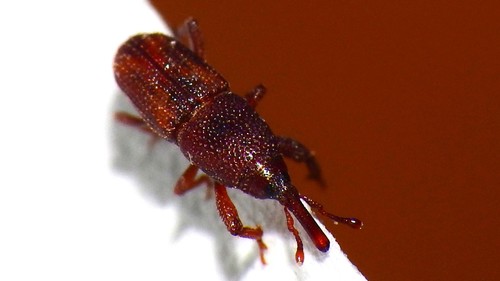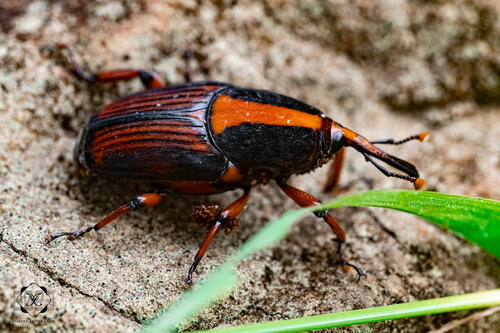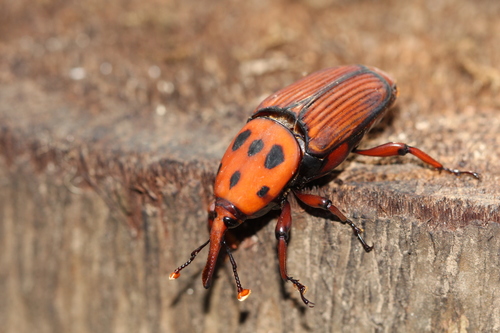
About Rhynchophorus ferrugineus (A.G.Olivier, 1791)
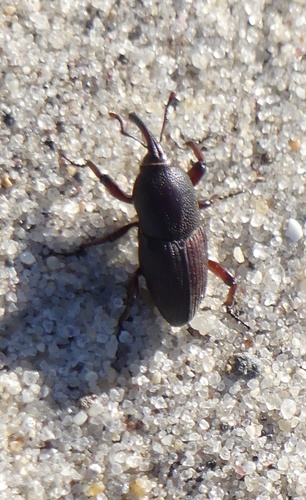
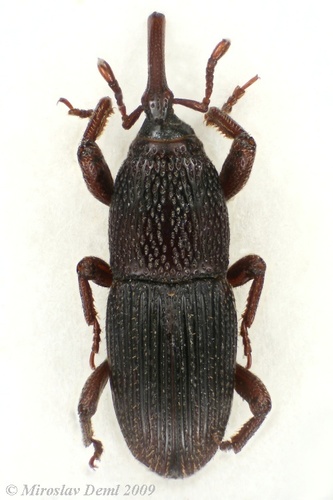
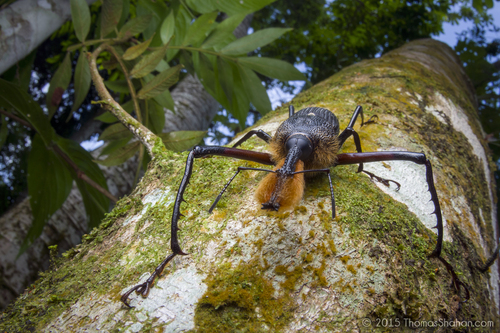
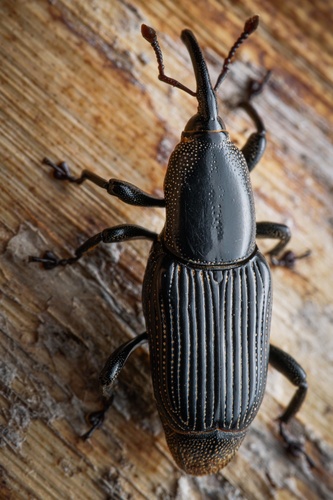
Rhynchophorus ferrugineus, commonly called the red palm weevil, Asian palm weevil, or sago palm weevil, is one of two snout beetle species that share these common names. Adult red palm weevils are relatively large, measuring 2 to 4 centimeters (1 to 1.5 inches) in length, and are typically rusty red in colour. Many colour variants exist, and these variants have often been misclassified as separate species such as R. vulneratus. Weevil larvae dig tunnels up to 1 metre (3.3 feet) long inside palm tree trunks, which weakens the host tree and eventually kills it. Because of this damage, the species is considered a major pest for commercial palm plantations including coconut palm, date palm, and oil palm. Red palm weevils are originally native to tropical Asia, but have since spread to Africa and Europe, first reaching the Mediterranean region in the 1980s. The species was first recorded in Spain in 1994, and in France in 2006. Confirmed infestations have also been found in Malta, multiple regions of Italy including Tuscany, Sicily, Campania, Sardinia, Lazio, Marche, Puglia, and Liguria, Croatia, and Montenegro. It is also well established across most of Portugal, particularly in southern areas of the country. It has also become established in Morocco, Tunisia, and other North African countries. The species was first reported in the Americas on Curaçao in January 2009, and was sighted the same year in Aruba. A 2010 report of red palm weevils in Laguna Beach, California, United States was later determined to be a misidentification of the closely related species R. vulneratus, and R. ferrugineus did not become established in the area. It was reported in Uruguay in March 2022, and has since spread to many regions of the country. R. ferrugineus larvae are considered a delicacy in Southeast Asian cuisine. In some areas, commercial farming of these larvae is strictly prohibited, to prevent accidental spread that could devastate agricultural plantation crops. The confirmed native range of R. ferrugineus includes Bangladesh, Cambodia, China, India, Japan, Laos, Pakistan, Philippines, Sri Lanka, Taiwan, and Vietnam. Most or all historical records of R. ferrugineus from Indonesia, Malaysia, Myanmar, Singapore, and Thailand actually refer to the separate species R. vulneratus. Confirmed, established introduced populations of R. ferrugineus have been documented in Albania, Algeria, Aruba, Bahrain, Bosnia and Herzegovina, Croatia, Curaçao, Cyprus, Egypt, France including Corsica, Greece, Israel, Italy including Sicily and Sardinia, Jordan, Kuwait, Libya, Malta, Monaco, Montenegro, Morocco, Oman, Palestine, Portugal including Madeira, Qatar, Saudi Arabia, Slovenia, Spain including the Balearic and Canary Islands, Syria, Tunisia, Turkey, the United Arab Emirates, and Uruguay. Unconfirmed records of R. ferrugineus from Australia, Papua New Guinea, Samoa, the Solomon Islands, and Vanuatu are most likely misidentified specimens of R. bilineatus, a closely related species that is native to that region. Red palm weevils most commonly infest palm trees younger than twenty years. While adult weevils do cause some damage through feeding, the greatest tree mortality is caused by larvae burrowing into the heart of the palm tree. An adult female red palm weevil lays roughly 200 eggs on new growth in the palm's crown, at the base of young leaves, or in open lesions on the plant. Eggs hatch into white, legless larvae. Larvae feed on soft palm fibres and terminal buds, tunneling through the tree's internal tissue over the course of about a month. In rare cases, full grown larvae can reach 6 to 7 centimeters (2.5 to 3 inches) in length. When ready to pupate, the larva exits the host tree and builds a cocoon from dry palm fibers in leaf litter at the base of the tree. The total life cycle from egg to adult takes approximately 3 to 4 months. In Vietnam specifically, R. ferrugineus larvae are a well known culinary delicacy. In Vietnamese cuisine, larvae are sometimes eaten alive alongside fish sauce. They are also prepared by toasting, frying, or steaming. They are served with sticky rice and salad, or cooked into porridge. In Vietnamese, these larvae are called đuông dừa, meaning coconut beetle-larva. Reports of edible "sago worms" from other regions such as East Malaysia and New Guinea refer to other related species of Rhynchophorus, not R. ferrugineus.