About Rhynchocyclus olivaceus aequinoctialis (P.L.Sclater, 1858)
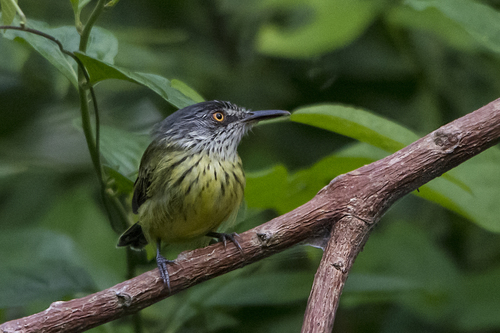
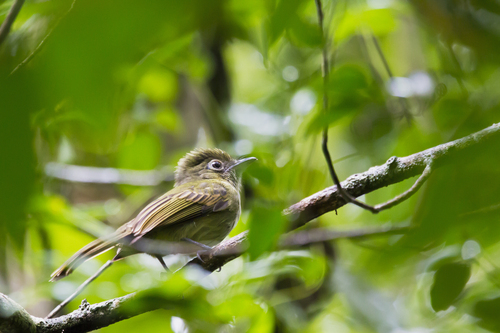
Eastern olivaceous flatbill (Rhynchocyclus olivaceus aequinoctialis) reaches about 15 cm (5.9 in) in length and weighs between 18 and 24.8 g (0.63 to 0.87 oz). Males and females have identical plumage. Adults of the nominate subspecies have a dark olive head with a white eye-ring, and all of their upperparts are dark olive. Their wings are dusky; the wing coverts and secondaries have ochre to buff edges that form two dull wing bars, and their tertials have yellow edges. Their tail is dusky, with paler outer edges on individual feathers. Their throat is pale gray to pale yellow, their breast is grayish olive, and their belly, flanks, and vent are pale yellow. The breast and flanks bear olive streaks. Juveniles have duller olive upperparts, paler yellow underparts, and more ochraceous olive uppertail coverts than adults. The other two subspecies have very similar plumage overall, though R. o. guianensis has a fainter eye-ring than the nominate subspecies. All subspecies have a dark brown iris, a wide flat bill with a black upper mandible (maxilla) and a pale horn lower mandible (mandible), and blue-gray to gray legs and feet.
The eastern olivaceous flatbill has a disjunct distribution. Subspecies R. o. guianensis occurs from Bolívar and eastern Amazonas states in Venezuela, east through the Guianas and into northern Brazil north of the Amazon, extending from the Negro River east to the Atlantic coast. Subspecies R. o. sordidus occurs across Brazil south of the Amazon, from the Tapajós River east to the Tocantins River and the Atlantic coast in northern Maranhão state. The nominate subspecies is found separately in northeastern and eastern Brazil, between the states of Pernambuco and Rio de Janeiro. This species primarily lives in humid terra firme forest and secondary woodland, and also occurs in várzea forest. It ranges in elevation from sea level up to 500 m (1,600 ft).