About Rhynchocyclus brevirostris (Cabanis, 1847)
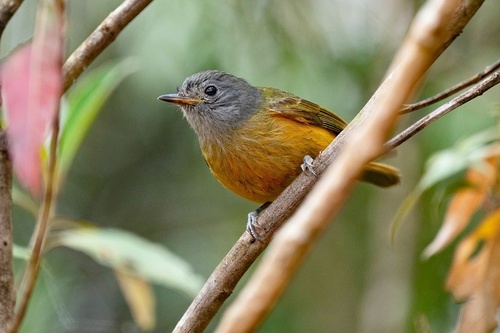
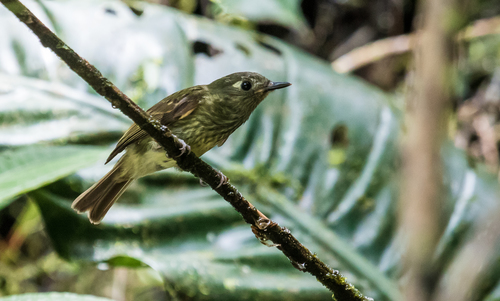
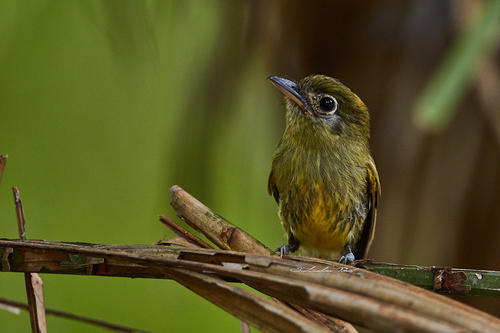
The eye-ringed flatbill (Rhynchocyclus brevirostris) is 15 to 17 cm (5.9 to 6.7 in) long and weighs 21 to 23 g (0.74 to 0.81 oz). The sexes have almost identical plumage. Adult birds have a bold white eye-ring, a faint dark smudge below the eye, grayish lores and cheeks, and a dusky patch behind their grayish ear coverts. The rest of the head and all upperparts are olive-green. The wings and tail are dusky, with paler yellow-olive edges along the feathers. Males have stiff, comb-like barbs on the outer primaries, which females do not have. For both sexes, the throat and upper breast are dull to dusky olive-green; this color becomes paler on the lower breast and sides, which also bear pale grayish yellowish streaks. The belly is pale yellow.
The species has three recognized subspecies. Subspecies R. b. pallidus is slightly paler than the nominate subspecies, but is otherwise identical. R. b. hellmayri is darker overall than the nominate and has a darker yellow belly. For both sexes of all subspecies, the iris is dark, the bill is large, wide, and flat with a black upper mandible and pale horn-colored lower mandible, and the legs and feet are gray.
The eye-ringed flatbill has a disjunct distribution. The nominate subspecies is the most widespread of the three. It is found from southern Veracruz, eastern Oaxaca, and the Yucatán Peninsula in southern Mexico, south along the Pacific slope through western Guatemala into El Salvador. To the east, it ranges south from Mexico through Belize, central and eastern Guatemala (excluding a central gap), eastern Nicaragua, and eastern Costa Rica, into Panama as far as Veraguas Province. It also occurs on the Pacific slope from west-central Costa Rica south and across northern Panama, where it connects to the eastern Panama section of its range. Subspecies R. b. pallidus inhabits the Pacific slope of Mexico in western Oaxaca, and likely ranges further north into adjacent Guerrero. R. b. hellmayri is found from Darién Province in eastern Panama, extending slightly into Chocó Department in extreme northwestern Colombia.
The eye-ringed flatbill lives in the interior and edges of humid evergreen forest, semi-deciduous forest, and cloudforest, as well as nearby secondary forest. It is mostly found between the upper edge of the forest understory and the forest mid-level, and particularly favors shady ravines. In Mexico and most of Central America, it occurs from sea level up to 2,100 m (6,900 ft); in Panama it occurs between 600 and 1,500 m (2,000 and 4,900 ft); and in Colombia it occurs between 600 and 1,700 m (2,000 and 5,600 ft).