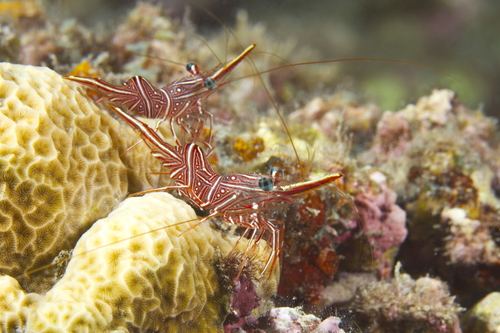
About Rhynchocinetes durbanensis Gordon, 1936
Rhynchocinetes durbanensis, commonly called the camel shrimp and hingebeak prawn, is a species of shrimp in the family Rhynchocinetidae native to the Indo-Pacific. This shrimp grows up to 4 cm (1.6 inches) in length, and has large black eyes, a translucent body marked with red and white lines, and many white ocelli (spots). It also has a Y-shaped white marking on the upper front section of its carapace. The species displays strong sexual dimorphism: dominant males have larger first pairs of chelipeds. This shrimp lives in hollows and crevices at depths between 5 metres (16 feet) and 35 metres (115 feet), and forms groups that can include dozens of individuals. One study has found that ovigerous females of this species carry between 267 and 1764 eggs. At a water temperature of 29.2 °C (84.6 °F), eggs hatch 9 days after spawning; if the temperature is below 22.0 °C (71.6 °F), hatching takes 18 days. R. durbanensis is frequently confused with R. uritai, and is also closely similar in appearance to R. brucei. It was first scientifically described by Isabella Gordon in 1936.

