About Rhyacotriton variegatus Stebbins & Lowe, 1951
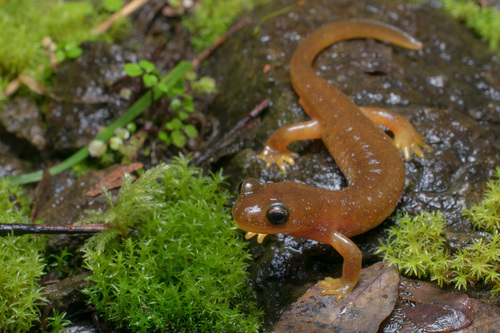
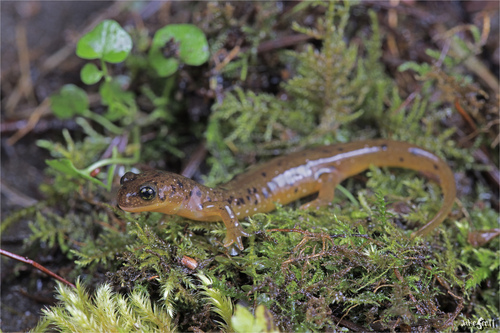
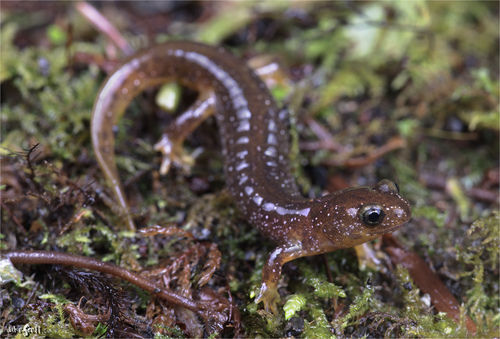
All species in the genus Rhyacotriton share similar morphological traits but have high genetic diversity. Rhyacotriton variegatus, commonly called the southern torrent salamander, lives in aquatic environments from the egg stage through metamorphosis. As adults, individuals live along water edges among pebbles and rocks. Among all North American salamanders, this species has the lowest desiccation tolerance, meaning it cannot easily withstand extreme temperatures and low moisture levels. It prefers calm, shallow, slow-flowing, high-oxygen habitats such as seeps and mountain brooks with coarse, gravel-like beds. These water sources occur primarily in forests, where this species is most often found. Like all Rhyacotriton species, R. variegatus has aquatic eggs and larvae, and adults are semi-aquatic. Adult southern torrent salamanders can move away from streams, but they prefer water, and only venture onto land when soil moisture is high enough. Both adults and juveniles are vulnerable to moisture loss and heat shock. Southern torrent salamanders are small salamanders; mature adults measure 1.5 to 2.4 inches from snout to vent. Their dorsal side is brown with darker spots, while their ventral side is more yellow and bears the same dark spots found on the dorsal side. Color shades vary: dorsal sides range from dark olive to dark brown. They have large, dark forward-facing eyes, surrounded by metallic flecks, generally blunt noses, and protruding eyes. Males can be distinguished from females by their square cloacal lobes. Adult southern torrent salamanders have reduced lungs, slender bodies, and long tails that are roughly the same length as their torsos. They have four legs arranged in pairs: two near the head and two near the base of the tail. Each foot has four toes used for gripping and climbing. The entire genus Rhyacotriton is native to the Pacific Northwest of North America, ranging from Northern California to Washington's Olympic Peninsula. R. variegatus is endemic to the southernmost portion of this genus-wide range, occurring from northern California to Oregon. Populations of this species are found in forests of California and Oregon's coastal region. Other Rhyacotriton species, primarily R. kezeri, occur further inland but still remain relatively close to the coast. R. variegatus populations occupy forested areas with freshwater sources that meet the species' habitat requirements. While most of the population forms a single continuous range, a smaller disconnected population is located in southwest Oregon, still close to the coastline. This species occurs specifically in coastal coniferous forests of California and Oregon. Populations are far more likely to persist in older forests, which typically have over 80% canopy cover from large trees and abundant moss. While some younger forests can provide suitable habitat to support populations, it is uncommon to find R. variegatus in young forests. Reproduction takes place in water, where fertilized eggs are laid and left unattended. Mating occurs after an extended courtship, and is followed by a lengthy egg-laying process. Eggs require a long incubation period to hatch, and the larval stage lasts approximately 2.0 to 2.5 years. Females usually lay one egg at a time, though occasional clutches of 8 to 11 eggs have been found.