About Rhus typhina L.
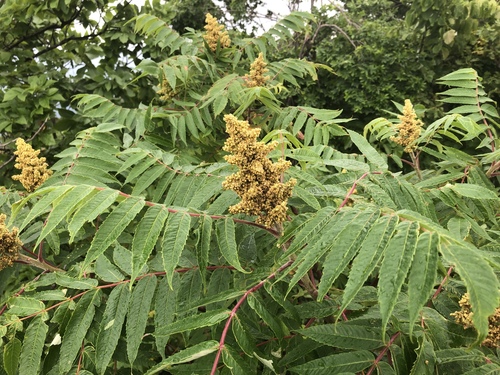
Rhus typhina L., commonly called stag's horn sumac, is a dioecious deciduous shrub or small tree. It grows up to 5 meters (16 feet) tall and 6 meters (20 feet) wide, and spreads via seeds and rhizomes to form clonal colonies. Colonies typically arrange older shoots at the center, surrounded by younger outer shoots, and large clones can develop from original ortet stems within just a few years. It produces alternate pinnately compound leaves 25–55 cm (10–22 inches) long. Each leaf holds 9–31 serrate leaflets that measure 6–11 cm (2+1⁄4–4+1⁄4 inches) long. Both leaf petioles and stems are densely covered in rust-colored hairs. The velvety texture and forking growth pattern of its branches resemble antlers, which gives the species its common name. This species grows as separate all-female or all-male clonal colonies. Small greenish-white to yellowish flowers form in dense terminal panicles, blooming from May to July within the species' native range. After flowering, small green to reddish drupes develop in dense terminal infructescences that measure 10–20 cm (4–8 inches) long and 4–6 cm (1+1⁄2–2+1⁄4 inches) wide at the base. Fruit ripens from June to September in the native range, and can remain on the plant from late summer through the following spring, when it is eaten by many bird species. Autumn foliage turns striking shades of red, orange, and yellow. In late summer, galls sometimes form on the undersides of leaves caused by the sumac leaf gall aphid Melaphis rhois; these galls are not significantly harmful to the plant. Staghorn sumac is grown as an ornamental plant that offers visual interest year-round. Its vigorous suckering growth habit makes it a poor fit for smaller gardens. It tolerates a very wide range of growing conditions, and is most often found growing in dry, poor-quality soil where many other plants cannot survive. Some landscape managers prune away all branches except the topmost ones to create a crown effect that makes the plant resemble a small palm tree. Numerous cultivars have been developed for ornamental garden use, and two have received the Royal Horticultural Society's Award of Garden Merit: the cutleaf staghorn sumac 'Dissecta', and Radiance ('Sinrus'). Multiple edible uses are documented for this species. Its fruit can be soaked and washed in cold water, strained, sweetened, and made into a lemonade-like drink called Sumac-Aid. The drink extract can also be processed into jelly. Young shoots can be peeled and eaten raw. Research has found the fruit has natural antioxidant and antimicrobial properties. All parts of the plant except the roots can be used as a natural dye and as a mordant. Staghorn sumac is high in tannins, and can be added to other dye baths to improve the light fastness of dyed materials. Leaves can be harvested for this use in summer, while bark can be collected year-round. The timber of this species has high chatoyance, with an average value above 20 PZC.