About Rhus ovata S.Watson
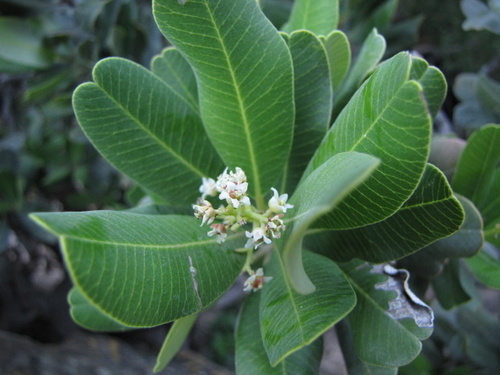
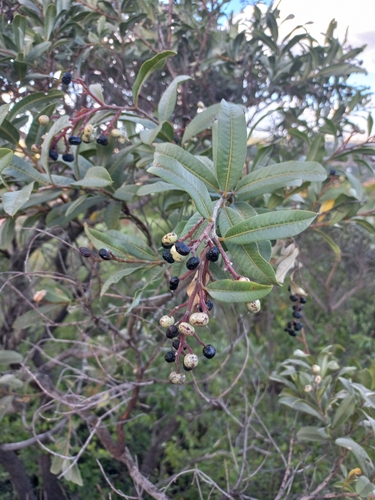
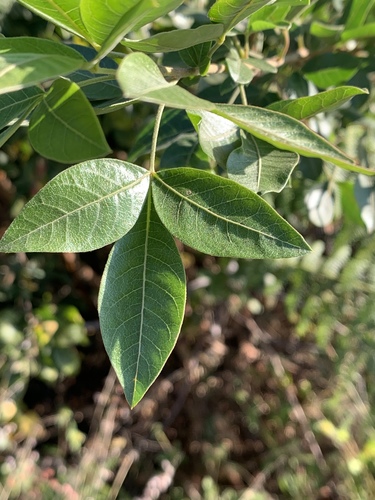
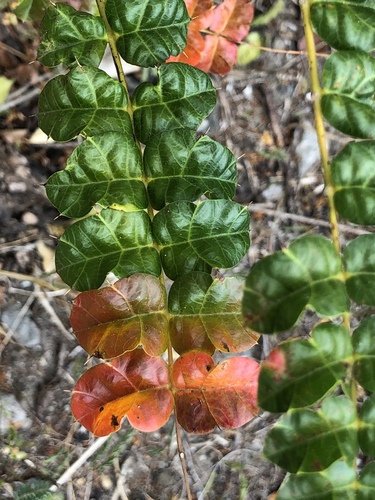
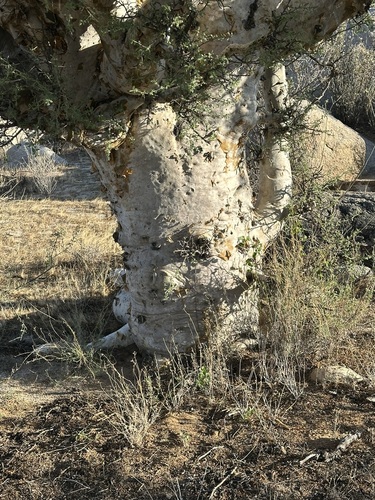
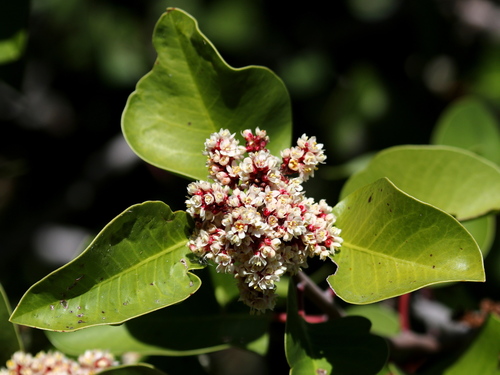
Rhus ovata S.Watson, commonly called sugar bush, is a woody plant that grows as a tall, wide shrub or a small tree, reaching 2 to 10 meters in height with a rounded overall shape. Young stout twigs are thick and reddish in color. Foliage grows on petioles 10 to 30 millimeters long. Its leaves measure 3 to 8 centimeters in length, and are roughly the same measurement in width; leaves are shaped broadly ovate to broadly elliptic, folded along the midrib, with a leathery, glabrous texture. Leaf tips range from acute to acuminate, and leaf margins are entirely smooth. The small flowers are less than 1 centimeter wide, made up of 5 white to pink petals and 5 reddish sepals with ciliate margins. This species is gynodioecious and self-incompatible: some plants produce only female flowers, others are hermaphroditic with bisexual flowers, and some produce a combination of male-sterile female flowers and bisexual flowers. Flowers grow in clustered branched inflorescences at the end of the current season’s branches. Inflorescence branches are stout, and bractlets are less than 2 millimeters in size. The fruit is a reddish, hairy, sticky drupe, 3 to 5 millimeters long and 6 to 8 millimeters in diameter, with a flattened shape. It produces a single seed surrounded by a stony endocarp, and male-sterile plants typically produce the highest number of fruits. This species is primarily found in inland locations, where it grades into its relative lemonade sumac near the coast, though it does occur on Santa Cruz Island and Catalina Island. It can be found throughout the inland mountains and foothills of Southern California, extending south through the Peninsular Ranges of San Diego County into northern Baja California, in the foothills and mountains of the Sierra de Juarez and Sierra de San Pedro Martir. Further south, more isolated disjunct populations grow in the sky islands of the Central Desert of Baja California, primarily in the mountains of the Sierra La Asamblea and Sierra San Borja. Its southernmost distribution is in Baja California Sur, on the Tres Virgenes volcano. The species also grows in a distant separate population in Arizona, on the Mogollon Rim. It can be found along canyon slopes in mountain foothills, most often in chaparral and associated ecosystems. It is a drought-tolerant species, and even grows along the edges of the Colorado Desert in the eastern foothills of the Peninsular Ranges. It prefers well-drained growing mediums derived from both granitic and sedimentary materials, and does not grow in alkaline soils. Flowers bloom from March to May, and are visited by many different bee species, including the Western honey bee, black-tailed bumblebee, and smaller bee genera such as Andrena, Perdita, Nomada, and Evylaeus. After pollination, fruits mature over the summer and can be collected from July to August. Most fruits fall to the ground to form a soil seed bank, though many remain on the plant into fall. Seeds may be consumed by the larvae of eurytomid wasps. Fruits and seeds of Rhus species are generally dispersed by birds and mammals; for the closely related Rhus integrifolia, many animals disperse fruits before they fall from the shrub. In wild populations, eurytomid wasp larvae may predate up to 50% of fallen seeds: a single larva enters a seed to eat its entire interior, then leaves a noticeable exit hole when it departs. Rodents and birds also interact with the fruits, eating or dispersing the seeds. Some rodents, such as the dusky-footed woodrat, strip and consume the plant’s bark, leaving entire branches bare. Pieces of sugar bush make up a minor portion of the food stored in dusky-footed woodrat nests. In cultivation, Rhus ovata prefers well-drained soil in a sunny location, and needs very little water once established, as it is highly drought-tolerant. It does not grow well after formal boxed pruning, but occasional autumn cutting down to just above the base crown can be done for new basal sprouting, for wildfire fuel reduction or plant rejuvenation. This plant is effective at controlling erosion.