About Rhoptropus bradfieldi Hewitt, 1935
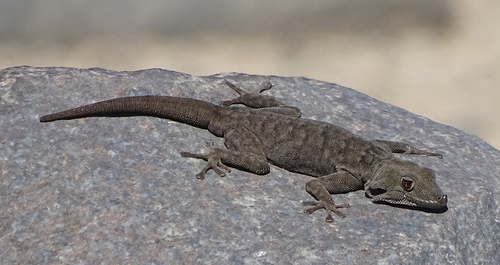
Rhoptropus bradfieldi has a maximum snout-to-vent length (SVL) of 74 mm (2.9 in), with a total length including the tail of approximately 100 to 130 mm (4 to 5 in). Its dorsal surface is greyish-brown, with indistinct barring and dappling, while its ventral surface is bluish-grey. There are eleven adhesive specialist structures called scansors located under its middle toe. This gecko resembles the closely related Namib day gecko (Rhoptropus afer) in appearance, but R. afer is slightly smaller, has bright yellow underparts, and only six scansors under its middle toe. The difference in scansor count between the two species, paired with the much shorter setae that form R. afer's scansors, corresponds to differing lifestyles. With more adhesive feet, R. bradfieldi is a crevice-dwelling species that follows a slow, climbing lifestyle, while R. afer is far more terrestrial, running quickly across the ground and jumping between rocks. Rhoptropus bradfieldi is endemic to Namibia, and its typical habitat consists of rocks and boulders in arid regions of the Namib Desert. This species is a diurnal lizard and an ambush predator that hunts small arthropods including ants, moths, and beetles. When active, it maintains a high but steady body temperature. It has a low field metabolic rate, approximately 26% of that of other desert lizards, but requires a relatively high water intake, which it most likely obtains from the fogs that frequently occur near the Namibian coast. Rhoptropus bradfieldi is oviparous. Its clutch size is two eggs, and each egg measures around 15 mm × 9 mm (0.59 in × 0.35 in).