About Rhoptropus afer Peters, 1869
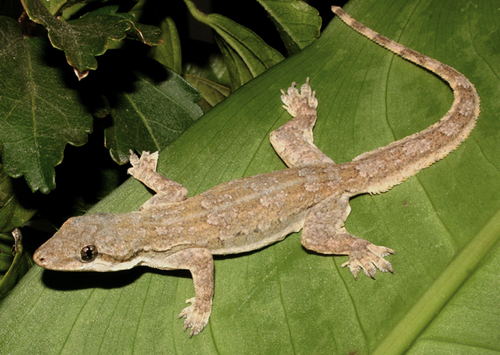
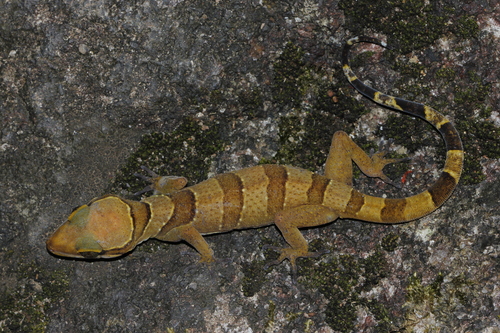
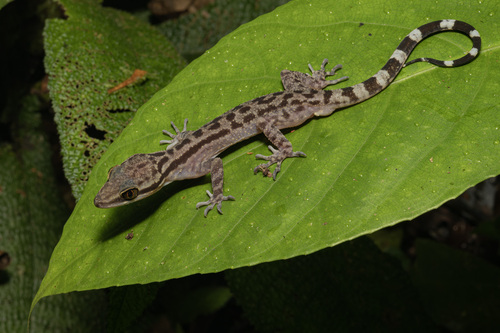
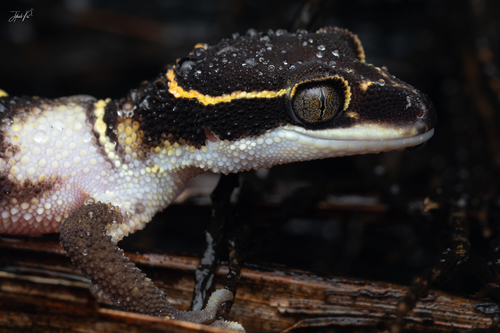
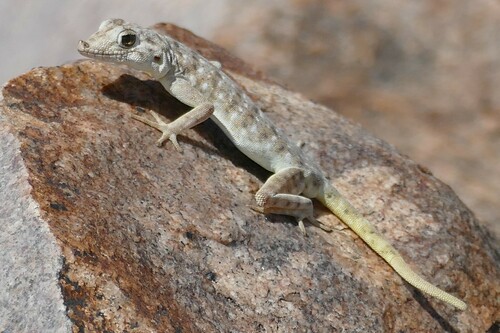
The Namib day gecko (Rhoptropus afer Peters, 1869) has a maximum snout-to-vent length of about 50 mm (2.0 in). Its dorsal surface is well-camouflaged dappled greyish-brown, covered in small, rounded scales. The throat, undersides of the tail, and undersides of the limbs are bright yellow; the tail is flashed at other geckos as a signal. This species has long legs and long digits, with the exception of the shortened inner toe. The tips of the digits are flared, and the underside of the central digit has five or six scansors, specialized structures that help the gecko's feet adhere to almost any surface.
Rhoptropus afer is native to southwestern Africa, and its range covers southern Angola and northern Namibia. Adapted to desert life, it occurs in a range of habitats along the Atlantic coast and extending many kilometres inland.
The Namib day gecko is a diurnal species that feeds mostly on ants and beetles. On hot but breezy days, it cools itself by climbing onto an elevated perch, raising itself high off the hot rock surface, and orienting its body to minimize sun exposure. All geckos have highly sensitive colour night-vision capabilities. Geckos in the genus Rhoptropus are diurnal; their ancestors were nocturnal, and the genus has secondarily returned to daytime activity. Compared to other members of its genus, the Namib day gecko is a runner rather than a climber. It uses its speed to escape potential predators, and can sprint at up to 2.5 m (8 ft) per second in bright light. In dim light, such as foggy coastal days, its maximum speed is significantly lower.