About Rhopodytes viridirostris (Jerdon, 1840)
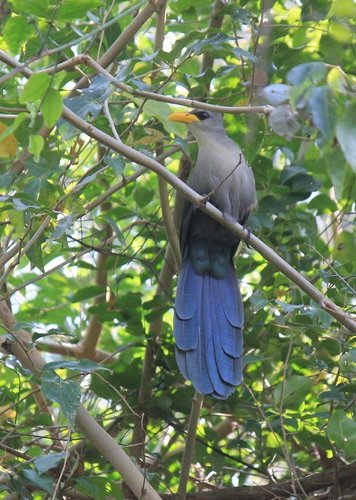
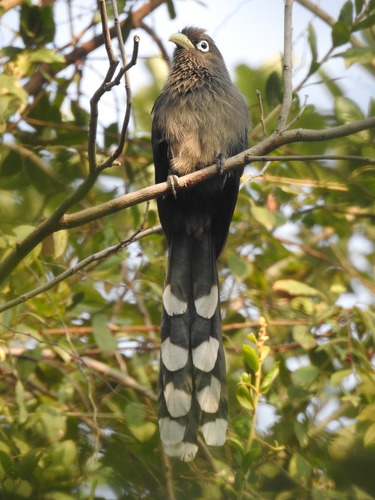
This is the blue-faced malkoha, with the scientific name Rhopodytes viridirostris (Jerdon, 1840). It is a relatively large species, measuring 39 cm in length. Its back and head are dark grey with an oily green or blue gloss. Its dark tail has graduated feathers tipped with white, while its belly ranges from pale ochre to grey. Unlike Phaenicophaeus tristis, this species has branched chin and throat feathers; the branched tips are pointed and slightly yellowish, which gives the throat a streaked, spiny appearance. There is a large blue patch around the eye, the iris is red with a white fringe, and the bill is apple green. The sexes cannot be distinguished from each other by external appearance. Individuals from Sri Lanka have broader white tips on their tail feathers. Malkohas are generally very silent, but will sometimes make a low croaky kraa call when flushed. Young blue-faced malkohas have dull, non-glossy upperparts, with some brown feathers on their wings. They nest inside thorny bushes, building a thick platform of twigs lined with green leaves. They lay a clutch of two chalky white eggs, rarely three. The breeding season is extended and not clearly defined, but many nests have been recorded between March and August. In one study of 31 trapped specimens, two were found to carry ticks of the species Haemaphysalis spinigera. The blue-faced malkoha feeds on a variety of insects, caterpillars, and small vertebrates, and usually forages in the undergrowth. The blue-faced malkoha occurs in peninsular India, south of Baroda (the Surat Dangs) and Cuttack, across a range of habitats including semi-evergreen forest, dry deciduous forest, and open scrub forest. In Sri Lanka, it is restricted to the plains. It has also been recorded in the Trichy district of Tamilnadu, India.