About Rhopocichla atriceps (Jerdon, 1839)
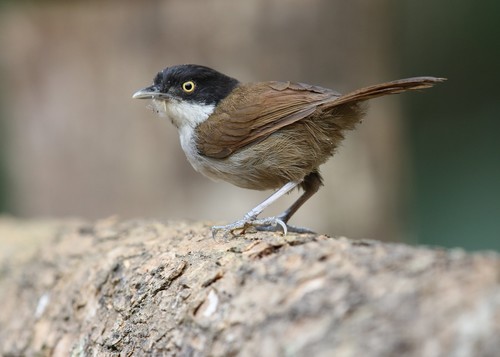
The dark-fronted babbler, scientifically named Rhopocichla atriceps, measures 13 cm long including its square-tipped tail. It has brown plumage on its upper body and white plumage on its underbody. The two subspecies native to the Western Ghats have full black hoods, while the two Sri Lankan races only have a dark bandit-style marking on the face. A distinct pale yellow iris creates a sharp contrast with the bird’s darker markings. The subspecies bourdilloni, found in the southern Western Ghats, has a duller sooty-black hood, a browner underside, and more olive-toned upper parts. The nominate subspecies, found north of the Palghat Gap, has a deep dark black hood. In Sri Lanka, the subspecies siccata occurs at lower elevations, while the subspecies nigrifrons occurs in the island’s wet zone. Siccata has more olive coloration on its upperparts, while nigrifrons has rufescent coloration on its upperparts. Dark-fronted babblers have weak flight and are permanent residents within their range. They forage in groups, clambering up vegetation; when disturbed, they typically drop from the topmost perches of bushes down into the undergrowth. Their typical habitat is undergrowth within forests, or more open growth along forest edges. Their diet consists mainly of insects. They can be hard to spot in the dense vegetation they prefer, but like other babblers, they are noisy birds. Their characteristic rattling churr alarm calls are often the best sign that these birds are present. They often join mixed-species foraging flocks. Their breeding season runs from May to July. This babbler builds its nest low down in a bush, forming a ball-shaped structure made of leaves, often bamboo leaves. The nest resembles a mass of dry leaves caught in a bush, with an entrance opening on the side. The usual clutch size is two eggs. Dark-fronted babblers are also reported to build separate dormitory nests, which birds sometimes use to roost. These dormitory nests are not lined.