About Rhopalosiphum maidis (Fitch, 1856)
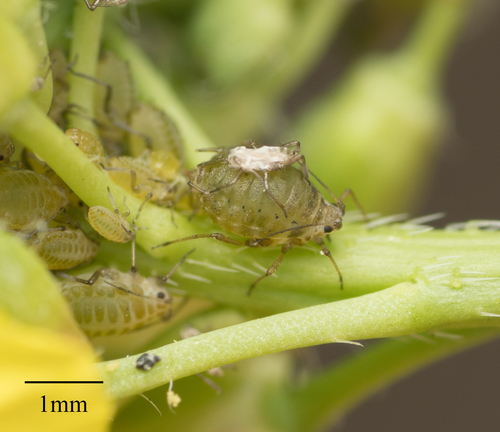
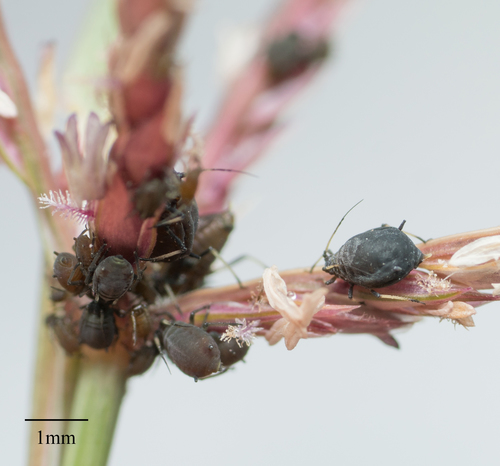
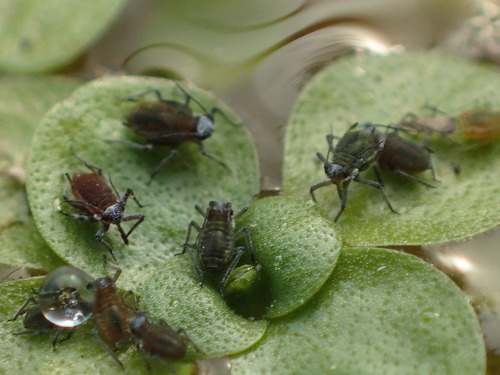
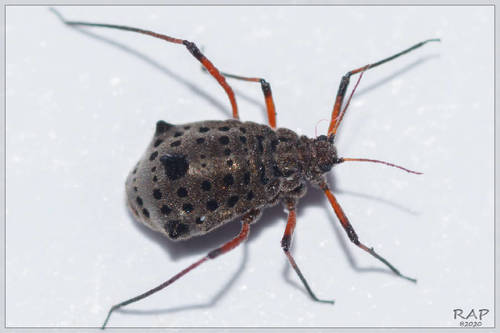
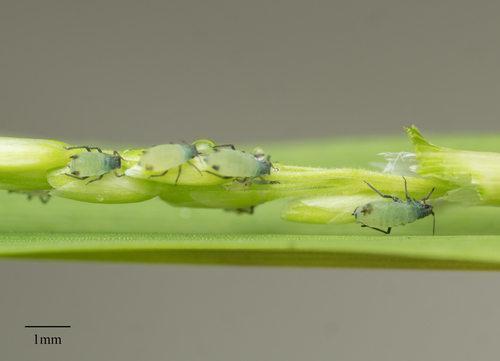
For wingless parthenogenetic female Rhopalosiphum maidis, bodies are green or whitish-green, while the head, antennae, legs, cornicles, tail, and transverse bands on the abdomen are black-brown. The body is covered in sparse short hairs. Antennae are less than half the body length, and cornicles are not longer than the finger-like tail. For winged female R. maidis, the head and thoracic section are black-brown, and their cornicles are shorter than those of wingless females. Most R. maidis populations are anholocyclic, meaning all reproduction occurs via parthenogenesis. Sexual reproduction has been recorded in Pakistan and Korea, where Prunus species act as the primary host. In populations from Japan and Kenya, males have been observed, but no sexually reproducing females have been found. In studies of chemical ecology, R. maidis grown on barley under enhanced carbon dioxide conditions showed significant decreases in growth rate and reproduction. Volatiles released by barley grown under enhanced CO2 were also less attractive to R. maidis than volatiles from barley grown under atmospheric CO2. Temperature and crowding produce different effects on wing formation in parthenogenetically reproducing R. maidis that live on barley. Maize inbred lines differ in their level of resistance to R. maidis and other insect pests. Compared to other aphid species that feed on maize (Rhopalosiphum padi, Schizaphis graminum, Sitobion avenae, and Metopolophium dirhodum), R. maidis has higher tolerance to benzoxazinoids, the most abundant class of defensive metabolites produced by maize. Even so, lineage-specific variation in maize resistance to R. maidis is linked to differences in the abundance of 2,4-dihydroxy-7-methoxy-1,4-benzoxazin-3-one glucoside (DIMBOA-Glc), a common maize benzoxazinoid. Both increased DIMBOA-Glc synthesis and reduced conversion of DIMBOA-Glc to 2-hydroxy-4,7-dimethoxy-1,4-benzoxazin-3-one glucoside (HDMBOA-Glc) can improve resistance of maize seedlings to R. maidis. Maize mutations that disable benzoxazinoid biosynthesis lead to increased R. maidis reproduction. In some cases, feeding by caterpillars can speed up the conversion of DIMBOA-Glc to HDMBOA-Glc, which in turn increases maize resistance to R. maidis. The defense signaling molecules 2-oxo-phytodienoic acid (OPDA) and ethylene take part in regulating maize resistance to R. maidis. Olfactometer experiments found that R. maidis are repelled by volatiles from damaged maize plants. One major volatile released by damaged maize is the terpene (E)‐β‐farnesene, which also acts as an alarm pheromone for aphids, meaning it may act as a repellent. Mutations to the maize terpene synthase gene TPS2 make maize plants more attractive to R. maidis.