About Rhombosolea plebeia (Richardson, 1843)
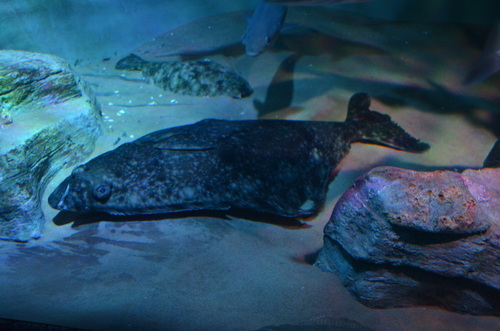
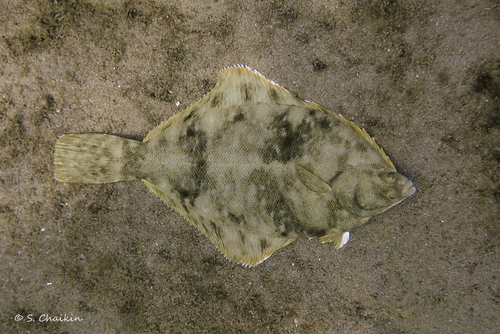
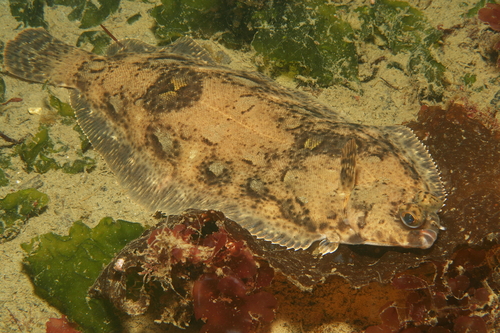
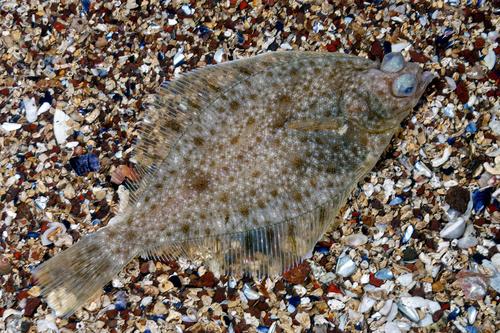
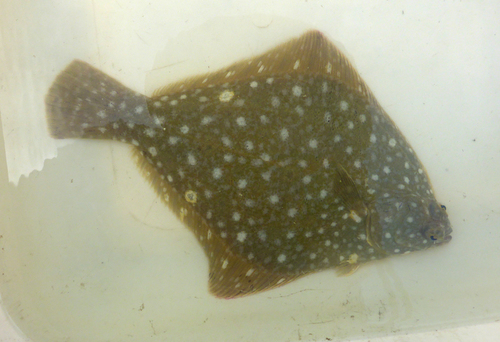
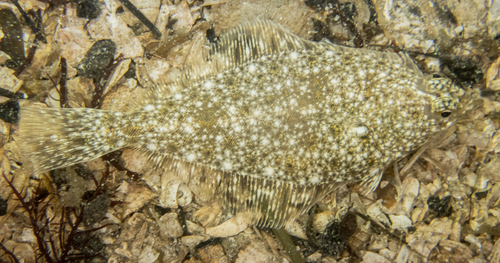
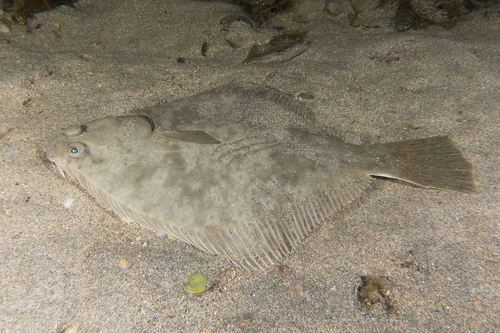
Like other flatfish, the larval sand flounder (Rhombosolea plebeia, also called the New Zealand sand flounder) starts life with one eye on each side of its head, a round body, and swims upright through midwater. As it outgrows the larval stage and enters the juvenile stage, one eye moves to the right side, leaving the other side blind, and the fish develops a flat diamond shape, swimming flat and parallel to the seabed. The right, eyed side of the fish is dark greenish brown or grey with faint mottling, while the left side (the side it lies on, which has no eyes) is white. What sets the New Zealand sand flounder apart from other flounder species in New Zealand is its yellow underside. The average length of an adult sand flounder is 25–35 cm, with a maximum recorded length of 45 cm. During the day, these fish lie on the seabed, where they are almost perfectly camouflaged in sand or mud. They have special pigment cells in their skin that can change colour to match their background, so only their protruding blue-green eyes give away their location. They swim with a flowing motion, using undulating movements of their side fins, and use their tail for propulsion when threatened by predators. Adult sand flounder swim on their side: a continuous dorsal fin runs along one edge of their diamond-shaped body, and an extended anal fin runs along the other edge. They have no swim bladder, and only leave the seabed to carry out courtship and spawning activities. This species is endemic to New Zealand, and is found across most of New Zealand's coastal waters. Its largest populations are in Tasman Bay and on the East Coast of the South Island. It can be found in harbours, inlets, bays, and open coastal water. It prefers coastal areas, and inhabits waters up to 50 m deep, and is rarely found deeper. It is common on mudflats, but appears to have no preference for specific bottom substrates; it is also found on bottoms of sand, clay, pebbles, and gravel, as well as in estuaries. Juvenile sand flounder stay in sheltered inshore areas such as estuaries, mudflats, and sand flats for around two years. This species prefers a temperate climate. The spawning period of the New Zealand sand flounder varies based on its geographic location. In northern New Zealand, spawning occurs over a long period from March to December, while in southern New Zealand, spawning largely takes place in spring. A study conducted in the Hauraki Gulf found that spawning sand flounder lay between 100,000 and 500,000 eggs, with variation in egg count attributed to differences in the size of spawning females. Larval sand flounder hatch after roughly one week; the exact hatching time depends on water temperature. Newly hatched larvae are less than half a centimetre long, have an eye on each side of the head, and swim upright like most other fish. They have a large yolk sac attached to their underside that provides nutrients until they are large enough to feed on their own. As they grow, larvae begin to use external food sources: first seaweed spores and algae, then small shrimp and plankton as they get larger. These extra nutrients allow them to reach around one and a half centimetres in length by three weeks old. Sand flounder have a bar of cartilage above each eye. When larvae reach this size, the cartilage above the left eye is absorbed, and the left eye begins moving across the head until it sits next to the right eye. The twisted shape of the adult sand flounder's mouth comes from shifts in the skull and bones as the left eye migrates to the right side of the body. During this slow migration process, the fish grows sideways, flattens, and loses its original rounded body shape. This metamorphosis makes the upright swimming that larvae used difficult and exhausting. The now-juvenile sand flounder sink to the bottom and begin swimming like adult flatfish: undulating their side fins, and using their tail for rapid acceleration. Juvenile R. plebeia migrate to shallow estuary and mudflat waters, where they remain until they mature at two years old. Once they reach mature age and size, they migrate to deeper water around 30 to 50 metres deep to spawn. After this first migration, they continue an annual migration pattern: moving to shallow 0 to 50 m deep waters in spring and summer, and to deeper 50 to 100 m deep waters in autumn and winter. Male R. plebeia are smaller than females. Males mature at 10 cm long and grow to 15–17 cm in total length. Females grow faster, mature at 16–20 cm long, reach 23–24 cm by age two, and grow to an average of 30 cm by age three. The average lifespan of the New Zealand sand flounder is three to four years, which gives them two full years of spawning.