About Rhomboplites aurorubens (Cuvier, 1829)
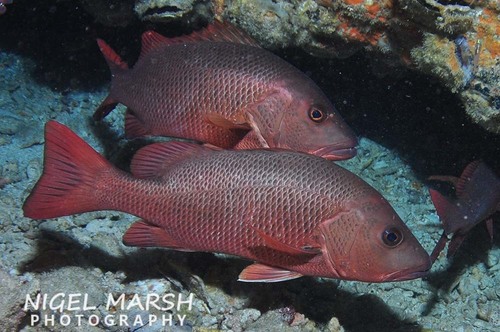
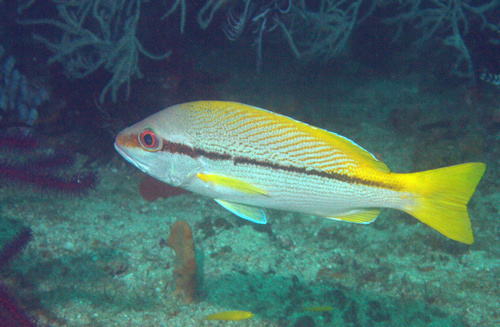
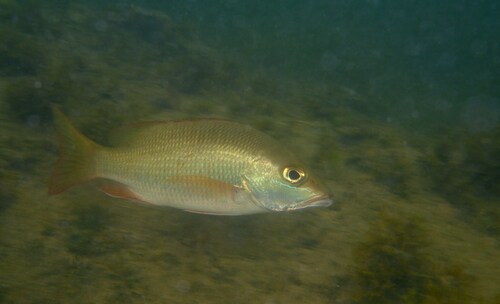
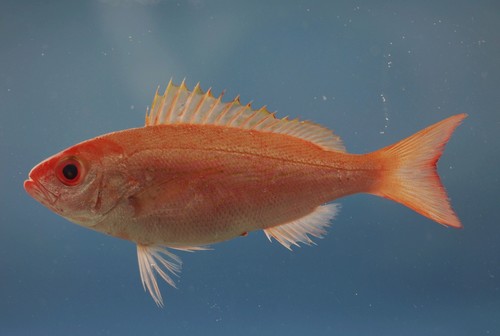
The vermilion snapper, Rhomboplites aurorubens, has an elongated, oblong body, a short snout, a slightly protruding lower jaw, and a small mouth. Two pairs of simple hole nostrils, one front and one rear, are located on the snout. When the mouth is closed, the upper jaw slides underneath the cheekbones. This species does not have enlarged canines in its jaws. Vomerine teeth are arranged in a triangular or rhombus-shaped patch with a wide rear extension, and a patch of granular teeth grows on the tongue. The dorsal fin has 12–13 spines and 10–11 soft rays. The anal fin has 3 spines, 8 soft rays, and a rounded shape. Pectoral fins hold 17–19 fin rays and are relatively short, not reaching the level of the anus. The caudal fin is moderately forked, rather than deeply forked. This species reaches a maximum total length of 60 cm (24 in), with 35 cm (14 in) being a more typical length, and has a maximum published weight of 3.2 kg (7.1 lb). Its overall body color is bright red, fading to pink on the lower flanks and to whitish on the abdomen. A series of short, wavy, oblique blue lines formed by scale spots run along the flanks above the lateral line, and yellow streaks may be present below the lateral line. The anal fin is pinkish red; the caudal fin is red with a black margin; the dorsal fin is red with a yellow margin; and the pectoral fins are red. The vermilion snapper is native to the Western Atlantic Ocean. Its range extends from North Carolina and Bermuda south along the eastern United States coast to the Bahamas, then through the Gulf of Mexico and Caribbean Sea, and continues south along the eastern coast of South America as far as Santa Catarina, Brazil. It inhabits waters between 20 and 300 m (66 and 984 ft) deep. Adults are most commonly found at moderate depths over rock, gravel, or sand substrates near the edge of continental and island shelves, while juveniles live in shallower waters.