About Rhodothraupis celaeno (Deppe, 1830)
The crimson-collared grosbeak, scientifically known as Rhodothraupis celaeno (Deppe, 1830, also referenced as Periporphyrus celaeno), is a medium-sized seed- and leaf-eating bird in the Cardinalidae family, the same family that includes the northern cardinal.
This species is primarily native to northeastern Mexico, where its range extends from central Nuevo León and central Tamaulipas south to northern Veracruz. It occasionally strays into the Rio Grande Valley of southern Texas, most often during winter.
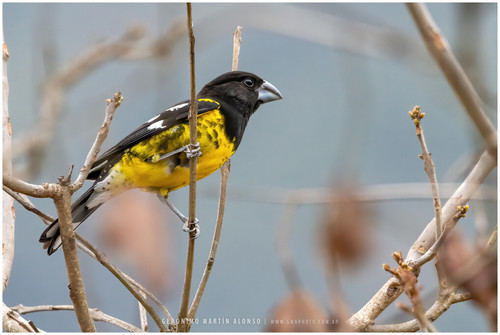
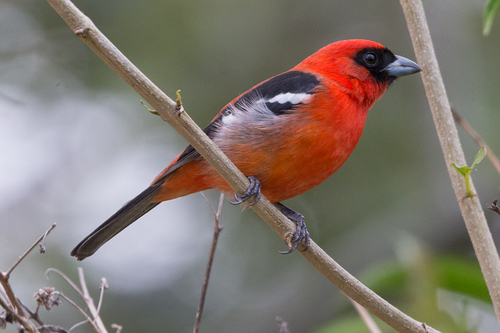
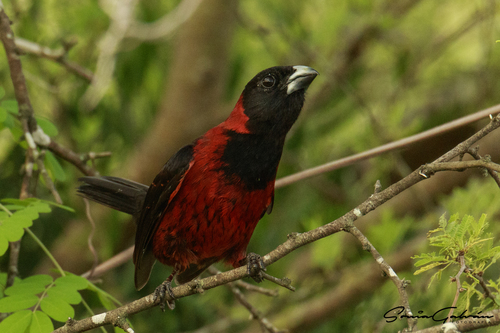
It measures 20.2–23.5 cm (7.95–9.25 in) in length, with an estimated average weight of 60 grams (2.1 oz). Mature males have black plumage, with a dull red or pinkish red "collar" marking the nape, shoulders, and belly—similar to the pattern seen on the crimson-collared tanager. The belly of mature males is mottled with black. Mature females share males' black head and breast, but have greenish upperparts and yellowish underparts. Young birds resemble adult females, but have less black coloration overall.
The beak of the crimson-collared grosbeak is black, large, and stubby, with the upper mandible protruding roughly perpendicular to the forehead. Its song is a warble, often slurred upward at the end. Its calls are penetrating whistles that begin with an "s" sound, and are slurred downward, or consist of one upward slur followed by one downward slur.
This species inhabits humid or semi-arid forest and second growth, occupying vegetation from low to high levels of the habitat, and will sometimes skulk for food on the ground. It can be found alone, in pairs, or in mixed-species flocks. It builds a bulky cup-shaped nest made of grass and twigs, placed in a bush. The female lays two or three pale blue-grey eggs marked with brown spots.