About Rhodostethia rosea (W.MacGillivray, 1824)
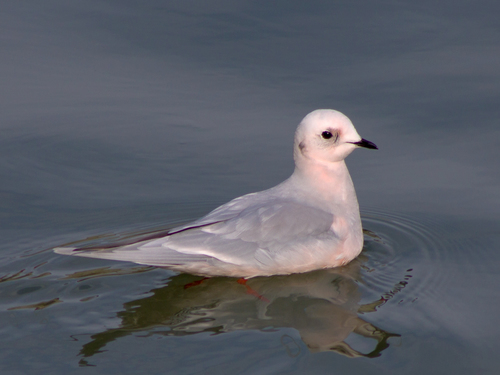
Ross's gull, scientifically named Rhodostethia rosea (W.MacGillivray, 1824), is a small gull species similar in size and some plumage traits to the little gull. It is slightly larger than the little gull, with longer, more pointed wings and a wedge-shaped tail, and it has red legs. Summer adult Ross's gulls have pale grey upperparts, white underparts, a pink flush to their body feathers, and a distinct neat black neck ring. In winter, the black neck collar disappears, and a small dark crescent forms behind the eye; the diet-related pink body color is lost in some, but not all, winter individuals. Young Ross's gulls look similar to winter adults, but they show a dark "W" pattern on their wings during flight, just like young little gulls, and they have no pink body coloration. Juveniles require two years to develop full adult plumage. The species has the following measurements: length ranges from 29 to 31 cm (11 to 12 in), weight ranges from 140 to 250 g (4.9 to 8.8 oz), and wingspan ranges from 90 to 100 cm (35 to 39 in). Ross's gull breeds in the high Arctic regions of northernmost North America and northeast Siberia. It only migrates a short distance south in autumn. Most of the population winters at northern latitudes along the edge of pack ice in the northern Bering Sea and the Sea of Okhotsk. Some individuals do reach more temperate areas, including north west Europe: single birds were sighted in Cornwall and Ireland in February 2016 per BTO BirdTrack, and two birds were observed in Belgium (one in Nieuwpoort, one in Zeebrugge) in December 2021. In North America, a Ross's gull has been spotted as far south as California's Salton Sea, though sightings this far south are extremely rare. Summer breeding grounds for the species are tundra that contains sedges, grass tussocks, dwarf willows, bushes, lichens, and pools.