About Rhodopis vesper (R.Lesson, 1829)
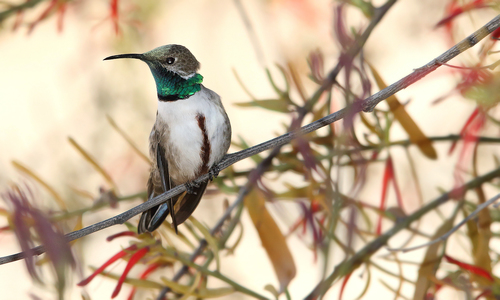
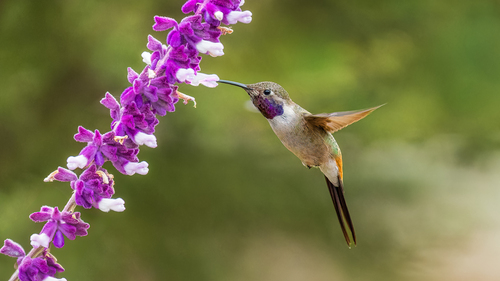
The oasis hummingbird, scientifically named Rhodopis vesper (R.Lesson, 1829), measures 11 to 13.5 cm (4.3 to 5.3 in) long and weighs approximately 4 g (0.14 oz). Both sexes have a long, black, decurved bill. The nominate subspecies is larger, with a longer and stouter bill, than the other two subspecies; the three are otherwise similar in appearance. Both sexes have olive green upperparts, with a cinnamon rump and uppertail coverts. Females have a small white dot behind the eye, while males have a longer white stripe there. Males have an iridescent gorget that ranges from rosy violet to purple, with turquoise coloring towards the rear. Their underparts are dull white, with a dull green wash on the flanks. The tail is deeply forked; its central feathers are grayish olive, and the remaining feathers are purplish brown. Females do not have the colorful gorget; their underparts are pale gray to pale buff, with darker flanks. Their tail is shorter than the male's and only slightly forked. The upper surface of the female's tail is olive green to bronzy green, and all but the central pair of tail feathers have a wide black bar near the end and white tips. Three subspecies of the oasis hummingbird are recognized with distinct distribution ranges. Subspecies R. v. koepckeae is known only from its type locality in the Department of Piura, northwestern Peru. The nominate subspecies R. v. vesper occurs from just south of that area, through Peru, into Chile's Tarapacá Region. R. v. atacamensis is found further south in Chile, between the Atacama and Santiago Metropolitan regions. The species' range expansion south of Atacama has taken place since the 1960s. The oasis hummingbird inhabits a variety of coastal and near-coastal landscapes, including arid scrublands and their oases, riparian zones, agricultural areas, and gardens. Its elevational range extends from near sea level to 3,800 m (12,500 ft), though across most of Peru it is mostly found below 2,600 m (8,500 ft).