About Rhododendron lapponicum (L.) Wahlenb.
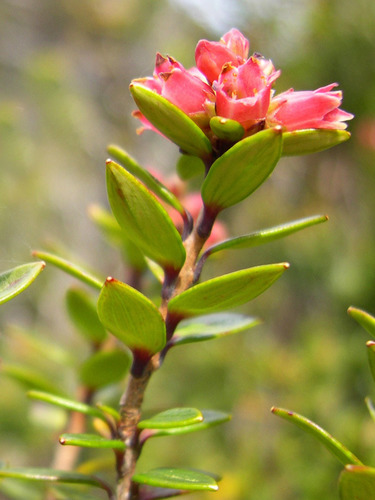
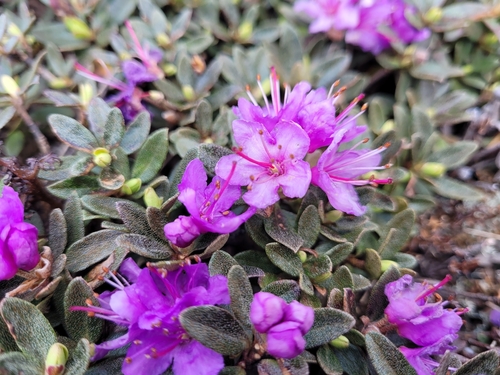
Rhododendron lapponicum (L.) Wahlenb. is a small perennial subshrub that can grow in either prostrate or erect forms, shaped by local growing conditions. In harsh alpine environments, it only reaches around 5 cm (2.0 in) in height. In milder locations, it can develop into a multi-branched shrub that grows from 20 cm (7.9 in) to 1 m (39 in) tall. It can produce clonal colonies via spreading rhizomes, and a single colony may live for several decades. Its evergreen leaves can grow in elliptic, ovate, or obovate shapes, and measure 0.4–2.5 cm (0.16–0.98 in) long. Leaves attach to stems via petioles that are 1.5 to 4 mm long. The leaves are coriaceous; the entire plant surface, including the petiole, is covered in golden or rust-colored scales. Leaf margins are entire, and can be either plane or revolute. The inflorescence is a fascicled raceme that holds 3 to 6 flowers. Each flower grows on a pedicel 2.5 to 14 mm long, and both the pedicel and calyx are covered in rust-colored scales. The corolla is broadly funnel-shaped and 0.65 to 1.5 cm wide. Petal color ranges from violet rose to purple, and is rarely white. Each flower has 5 to 10 stamens that are 7 to 13 mm long. This species flowers during spring and summer, with exact timing depending on latitude and elevation. The fruit is a cylindric-ovate capsule that measures 4 to 7 mm long by 2 to 3 mm wide, and is densely covered in rust-colored scales. Seeds are ellipsoid, smooth, yellowish, and 1 to 1.2 mm long.
Rhododendron lapponicum has a wide circumpolar distribution, growing in arctic and alpine tundra environments across northern North America, northern Europe, and northeastern Asia. It grows at elevations ranging from sea level to 1,900 m (6,200 ft). It can be found in rocky barrens, heaths, bogs, beach ridges, and sandy stream banks. In eastern alpine ecosystems, it is commonly associated with cushion-tussock and heath-shrub-rush plant communities. In North America, it occurs mostly across Alaska, Canada, and Greenland. In western Greenland, it is known to hybridize with Rhododendron tomentosum to produce the hybrid species Rhododendron × vanhoeffenii. In the contiguous United States, it was historically recorded from only four locations: Mount Marcy in New York, the Presidential Range in New Hampshire, Mount Khatadin in Maine, and two sandstone ledge sites in the Driftless Area of southwest Wisconsin. In July 2015, a previously unknown population of Rhododendron lapponicum was identified in Chittenden County, Vermont. It is unclear when this population became established, but there is no evidence that it did not establish through natural means. These disjunct populations are likely remnants of a more widespread southerly distribution of the species that existed during, or soon after, the last glacial advance. In Europe, the species is native to the Scandinavian countries of Norway, Sweden, and Finland. In Asia, it can be found in Northeast China, Inner Mongolia, Mongolia, Japan, North Korea, and Siberia.