About Rhododendron groenlandicum (Oeder) Kron & Judd
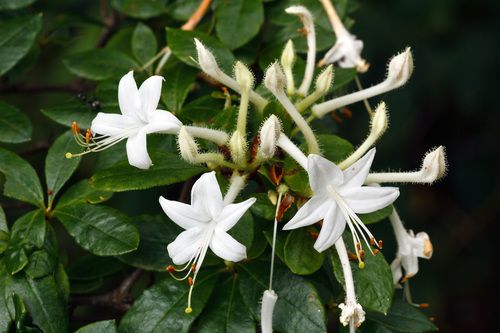
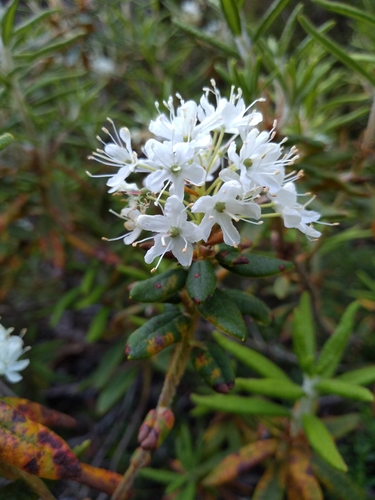
Rhododendron groenlandicum (Oeder) Kron & Judd is a low growing evergreen shrub. It typically reaches 50 cm (20 in) tall, and rarely grows as tall as 2 m (6 ft 7 in). Its leaves measure 2–6 cm (3⁄4–2+3⁄8 in) long and 3–15 mm (1⁄8–5⁄8 in) broad, with a leathery texture, wrinkled upper surfaces, and a thick waxy cuticle. The underside of leaves is covered in dense white hair that turns red-brown as the leaf ages. This species produces small, white, perfect bisexual flowers arranged in hemispherical clusters that hold up to 35 flowers each. Flower petals are approximately 1 cm long, with 5 oval petals per flower. The flowers produce a sweet aroma and sticky nectar to attract pollinators. Rhododendron groenlandicum is self-compatible, but self-fertilization results in lower fruit set and fewer seeds per fruit than cross-pollination. Pollination is primarily done by bees, though butterflies and beetles can also act as pollinators for the species. It is found in Greenland, every province and territory in Canada, and the northern United States, including the Northeast (New England, New York, Pennsylvania), the Northwest (Oregon, Washington, Idaho, Alaska), and parts of the Upper Midwest (Michigan, Wisconsin, Minnesota). It grows in bogs, muskegs, and open tundra, and occasionally grows on wet shores and rocky alpine slopes. The plant contains toxic alkaloids that are poisonous to livestock, and may be toxic to humans when consumed in concentrated doses. Many Native American tribes, including the Quinault, Makah, Potawatomi, Anishinaabe, Iroquois, and Canadian First Nations tribes, regularly use its leaves to make beverages and medicines, most commonly a fragrant tea. Compounds from this plant have been found to have antioxidant, anti-inflammatory, and anticancer activity. European explorers adopted these traditional uses soon after their arrival, and named the preparation "Indian plant tea". During the American Revolutionary War, it was used as a substitute for imported tea. Before hops became the primary flavoring and preservative ingredient for ale, Europeans used this plant to flavor ale. Rhododendron groenlandicum is sometimes grown as an ornamental shrub, and its essential oil is popular for use in aromatherapy.