About Rhododendron arborescens (Pursh) Torr.
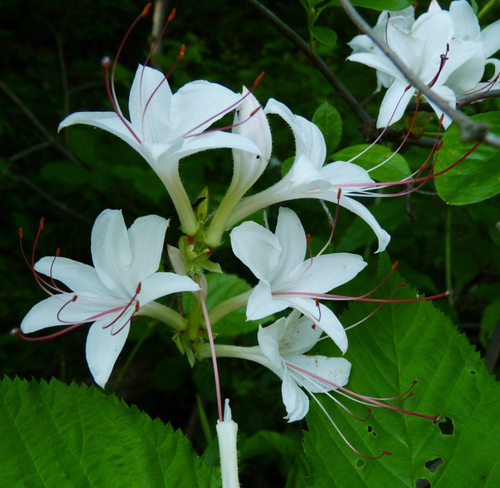
Rhododendron arborescens (Pursh) Torr. is a deciduous shrub that reaches up to 5.5 m (18 ft) in height. It produces terminal inflorescences that grow from the ends of stems, and typically has yellowish-brown twigs. Its green, waxy leaves are oval with smooth entire margins, rounded tips, and hairy midribs, ranging from 4.4–7.6 cm (1.75–3 in) long. Plants growing at higher altitudes are usually smaller overall, with smaller leaves. The plant produces 3 to 7 flowers after new leaf growth develops a white or blue tint, and its stigmas are clearly visible extending all the way up to the petals. This species is distributed in the eastern United States, specifically recorded in parts of West Virginia, Pennsylvania, Tennessee, North Carolina, Georgia and Alabama. It grows in mountain streamside areas or moist forests. It is a known late bloomer, with a blooming period ranging from early April to September. Rhododendron arborescens contains andromedotoxins, specifically the water-soluble diterpenoid compounds called grayanotoxins. Both its leaves and flowers contain these toxins, and consuming as little as 3 milliliters of its nectar per kilogram of body weight can be extremely harmful. For cultivation, R. arborescens grows best in slightly acidic soil with a pH between 5.5 and 6. It does not tolerate excessive water, so good drainage is required for healthy growth. It can tolerate full sunlight but should not be overexposed. It benefits from being planted with its roots slightly above ground level, with soil built up around the root system. Adding organic matter such as sawdust and pine bark supports the plant's growth. Applying a layer of a few inches of pine bark or wood chips around the plant helps retain soil moisture and prevent weed growth. Mature specimens do not require fertilizer feeding. This plant has been awarded the Royal Horticultural Society's Award of Garden Merit.