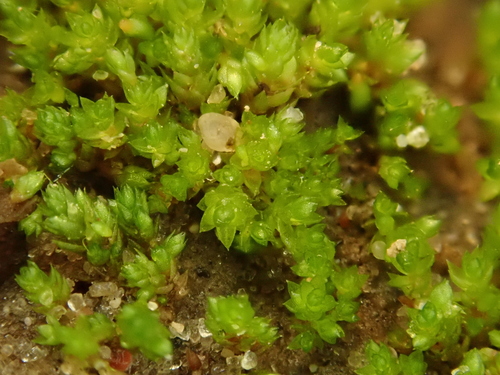
About Rhodobryum roseum (Hedw.) Limpr.
Rhodobryum roseum (Hedw.) Limpr. forms characteristic leaf rosettes at the tips of secondary stems, which grow from a wiry, creeping primary stem. Each rosette holds roughly 18 to 22 leaves, and has a similar appearance to a small green rose. The leaf margins are revolute, and finely toothed near the leaf tip, which terminates in a short mucronate point. The leaf midrib is prominent. Leaves that grow on the primary stem are small and scale-like, while the basal leaves on secondary stems are also very small. This species can be found growing in short grassland within open woodland, and occasionally occurs in forests, heaths, sand dunes, chalk grassland, grassy rock ledges, and on tree trunks. Rhodobryum roseum is a useful medicinal species. Its extracts, including ursolic acid, flavonoids, and alkaloids, have been used in cardiac research and other areas of medical research. Mosses display great diversity in the morphology and anatomy of their gametophytes and sporophytes. Due to their small size, it is difficult to distinguish Rhodobryum roseum from its adulterants using traditional methods. Specifically, Rhodobryum roseum is often confused with Rhodobryum ontariense, Plagiomnium actum, Plagiomnium maximoviczii, and Mnium laevinarve, which are closely related taxa.