About Rhodiola integrifolia Raf.
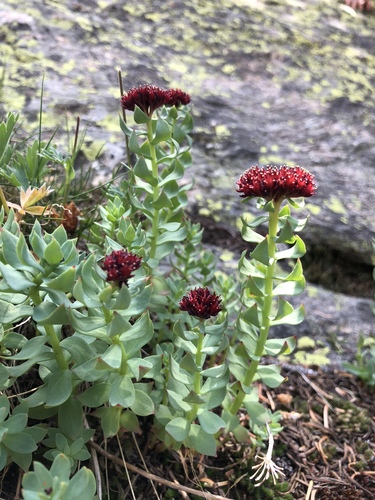
Rhodiola integrifolia is a species of flowering plant in the stonecrop family, commonly known as ledge stonecrop, western roseroot, and king's crown. It is native to the far northeastern part of Russia (including Kamchatka) and western North America. It grows in mountainous subalpine and alpine climates, in habitats such as meadows, cliffs, and talus. This perennial herb grows a stout stem from a fleshy, branching caudex, and reaches a maximum height of around 30 centimeters. Its fleshy leaves are alternately arranged along the stem, and range from widely lance-shaped to oval with pointed tips. They are flat but curve upwards toward the tip, and grow up to 2.5 centimeters long. Young leaves are green, and turn orange, rose, or red as they age. The inflorescence is a dense cyme that holds up to 50 flowers, which have fleshy petals in shades ranging from bright red to deep purple. The fruits are red, rounded oval shapes with pointed tips. There are several subspecies of Rhodiola integrifolia; one subspecies, ssp. leedyi, is very rare and restricted to just a few populations in Minnesota and upstate New York. This subspecies is considered a glacial relict, left over from periods when its current range was covered in glaciers. It survives on barren cliffs that stay cool from air moving through cave cracks. In the United States, ssp. leedyi is classified as a federally listed threatened species. In 2024, a team from Cornell University successfully established a new population of this subspecies in a nearby canyon, working to prevent the plant from going extinct.