About Rhodinia fugax Butler, 1877
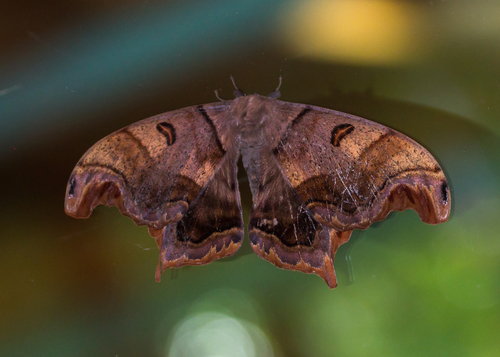
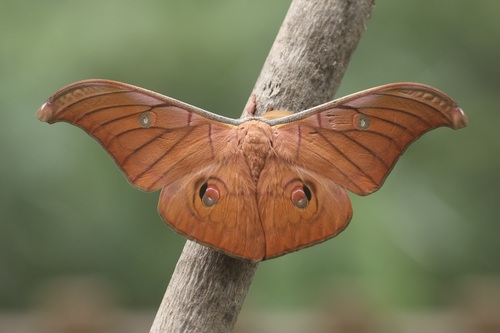
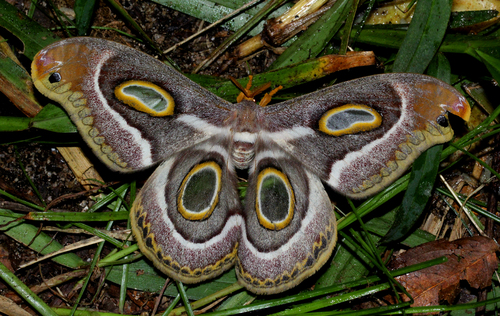
Rhodinia fugax, commonly called the squeaking silkmoth, has a total wingspan ranging from 75 to 110 millimeters. This species is sexually dimorphic, with males consistently smaller than females: male wingspans fall between 75 and 90 millimeters, while female wingspans range from 80 to 110 millimeters. The species' coloration matches that of autumn oak leaves, which acts as camouflage. Both sexes have translucent eyespots on their wings and hairy bodies; the hairy bodies help with thermoregulation, since adult moths emerge late in the autumn season. Male Rhodinia fugax have more variable appearance than females. Males can be yellow, orange, brown, or black, and are always darker than females. Females are always yellow, with variation in the thickness and color intensity of their submarginal band. Male forewings are more elongated, while female forewings are more rounded. The squeaking silkmoth is distributed across Korea, Japan, China, and the Russian Far East. In Japan, it occurs across the main islands of Hokkaido, Honshu, Shikoku, Kyushu, and has additionally been sighted on Sado Island. In China, the species is recorded from the provinces of Hebei, Heilongjiang, Henan, Inner Mongolia, Jilin, Liaoning, Ningxia, Shandong, and Shanxi. A 2007 discovery by Ronald Brechlin extended the known range in China as far south as Guangdong province and as far west as the Tibet Autonomous Region. Several subspecies are recognized with distinct distributions: the nominate subspecies R. f. fugax occurs across the Japanese main islands of Honshu, Shikoku, and Kyushu; subspecies R. f. diana is found on the northern Japanese island of Hokkaido, and has also been recorded in Manchuria and the Russian Far East; subspecies R. f. szechuanensis occurs in the Chinese provinces of Sichuan and Yunnan; subspecies R. f. shaanxiana is found in Shaanxi province, China; subspecies R. f. jiangxiana occurs in Jiangxi province, China; subspecies R. f. guangdongensis is found in the Chinese provinces of Guangdong and Hunan; and subspecies R. f. flavescens occurs in the Tibet Autonomous Region, referred to as "Xizang Zizhiqu" in Brechlin's original description. Adult Rhodinia fugax inhabit Satoyama hillsides, flatlands, and mountainous regions.