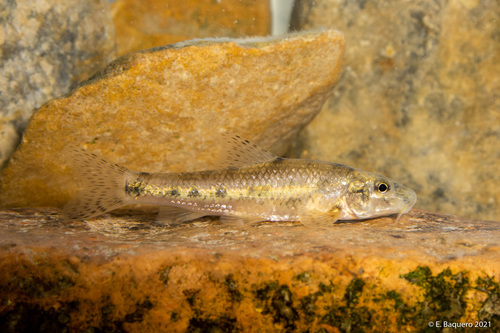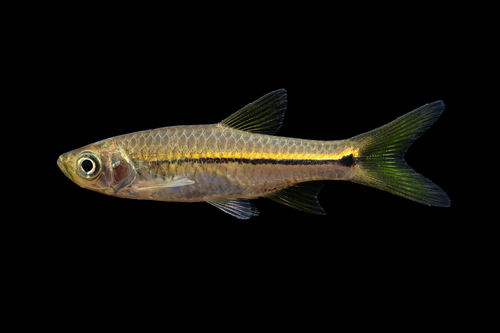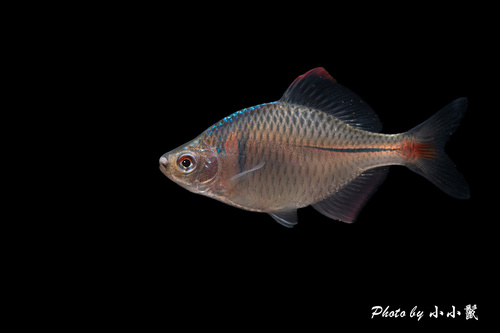
About Rhodeus ocellatus (Kner, 1866)
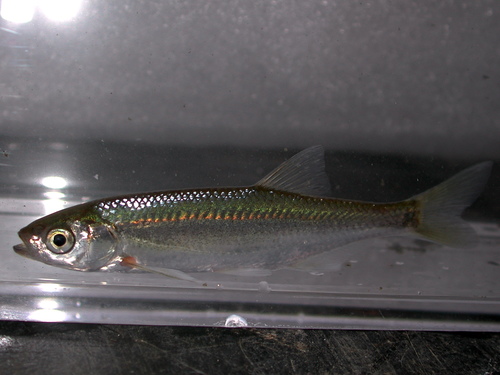
Rhodeus ocellatus (Kner, 1866), commonly called the rosy bitterling or Tairiku baratanago, is a small freshwater ray-finned fish in the bitterling family Acheilognathidae. This species is found across East Asia, from the Amur River basin south to the Pearl River basin. Adult females reach around 4–5 cm (1.6–2.0 in) in length, while males grow to 5–8 cm (2.0–3.1 in). Individuals have flattened bodies with a silvery luster; during the spawning season that runs from March to September, males develop a reddish, sometimes purple, breeding color to attract females. This red hue matches the color of a red rose, giving the species its common name rosy bitterling.
Rosy bitterlings live in ponds and reservoirs where freshwater mussels are plentiful, and farm ponds serve as important habitat for this species, as well as for mussels and plankton. Freshwater mussels are critical to the reproductive cycle of the rosy bitterling. Females have a unique ovipositor (egg-laying tube) roughly as long as their own body, which they use to deposit eggs directly onto a specific area of a mussel. Typically, a female lays two or three eggs at a time onto the mussel's gills. Immediately after a female lays her eggs, a male releases sperm into the mussel's gill cavity to fertilize the eggs. In a single spawning season, females usually lay eggs repeatedly, with intervals of 6 to 9 days between clutches, for a total of around 10 clutches per season.
Eggs develop inside the mussel's gills, and juveniles remain inside the mussel for 15 to 30 days after fertilization. Eggs hatch after about three days, when newly hatched juveniles are approximately 2.8 mm long, with a distinctive shape that resembles a matsutake mushroom bud. Once fully developed, juveniles exit the mussel through the edge of its excurrent siphon. At the time they leave the mussel, juveniles measure about 7.5 mm long and already have the same general body shape as adult rosy bitterlings. Juveniles usually grow to 40–50 mm within one year, at which point they reach adulthood.
Rhodeus ocellatus and the Japanese rosy bitterling, Rhodeus smithii, were formerly classified as a single species. In 1942, rosy bitterlings were accidentally introduced to Japan from mainland China, alongside imported grass carp (Ctenopharyngodon idellus) and silver carp (Hypophthalmichthys molitrix). After their introduction, the population of rosy bitterlings has increased dramatically across Japan. Hybridization and subsequent gene introgression between the two species has been recorded in Kashima and Ogori. As a result of this interbreeding, the population of Rhodeus smithii has declined sharply across Japan, and the species is now at risk of extinction. In 1994, R. smithii was listed as an endangered species on the IUCN Red List, and it is currently classified as critically endangered.