About Rhodanthe floribunda (DC.) Paul G.Wilson
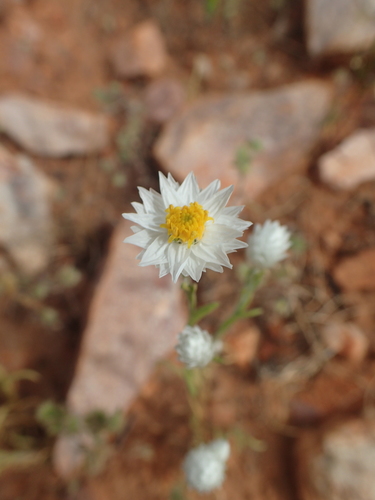
Rhodanthe floribunda, commonly called common white sunray, is an upright or ascending, bushy annual plant that grows up to 30 cm (12 in) tall. Its woolly or nearly smooth stems grow from the plant's base. The leaves are stalkless, narrow, linear, and greyish-green, measuring 10–20 mm (0.39–0.79 in) long and 0.5–2 mm (0.020–0.079 in) wide, with a rounded tip. The flower heads are 1–2 cm (0.39–0.79 in) in diameter, and grow individually at the ends of leafy small branches. The bracts are arranged in multiple rows; they are white, dry, and pointed, mostly held upright, while the inner bracts spread outward. The corolla is about 5 mm (0.20 in) long, toothed, and each flower head holds 20 to 50 yellow florets. Flowering takes place from August to January, with most flowering occurring in spring. The fruit is a rounded achene around 3 mm (0.12 in) long, covered in soft, silky, weak hairs. This species grows in semi-arid locations across New South Wales, Victoria, Queensland, Western Australia, South Australia, and the Northern Territory, thriving in a variety of soil types including sand and clay.