About Rhizostoma pulmo (Macri, 1778)
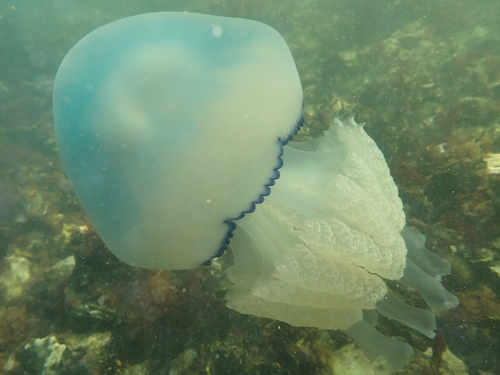
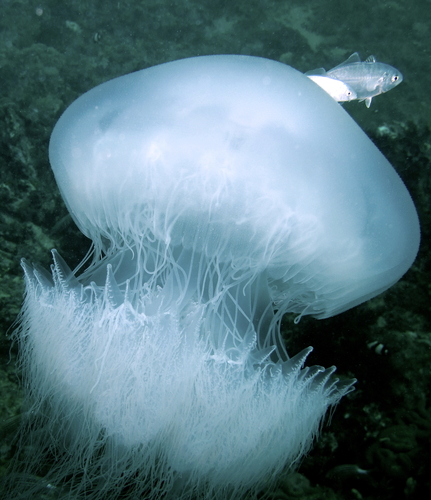
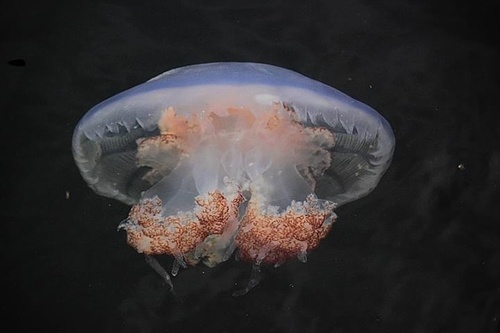
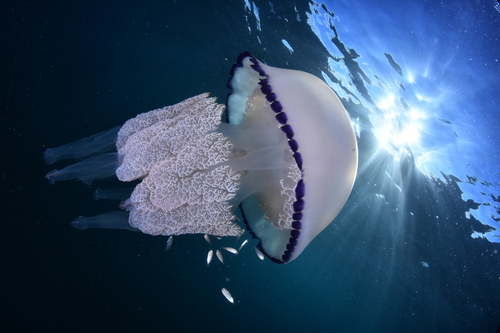
Rhizostoma pulmo (Macri, 1778), commonly known as the barrel jellyfish, dustbin-lid jellyfish, or frilly-mouthed jellyfish, is a scyphomedusa belonging to the family Rhizostomatidae. This species is found in the northeast Atlantic, Adriatic Sea, Mediterranean Sea, Black Sea, and Sea of Azov. It also occurs in the southern Atlantic off the western South African coast, extending into False Bay, and is common in the Irish Sea. R. pulmo typically occurs in increased populations, called blooms, during late summer and early autumn. These blooms are caused by higher water temperatures and other environmental factors such as wind. Most individuals of this species reach up to 40 cm (16 in) in bell diameter, but exceptionally large specimens can reach 150 cm (59 in) or larger, making it the largest jellyfish found in British and Irish waters (note that Cyanea capillata, the lion's mane jellyfish, reaches an even larger maximum size overall, but is generally smaller in British waters). The species can grow up to one meter (3.2 feet) in size and weigh up to 25 kilograms (55 lbs). Rhizostoma pulmo is moderately venomous relative to other jellyfish species. Stings on humans produce effects including a mild burning sensation on the skin, dermatitis, and ulcers. While the species is confirmed to be toxic, it does not pose a serious threat to human life. The leatherback turtle feeds preferentially on Rhizostoma pulmo. In Asia, this jellyfish is a source of bioactive compounds used in traditional food and traditional medicine. One study suggests that washing extracts in aqueous solutions and separating high molecular weight proteins from the extract, for example by membrane filtration, can be a method to remove possible toxic compounds from jellyfish extracts and concentrate potentially bioactive soluble compounds. These potentially active soluble components may have applications as nutraceutical and cosmeceutical ingredients.