About Rhizoprionodon acutus (Rüppell, 1837)
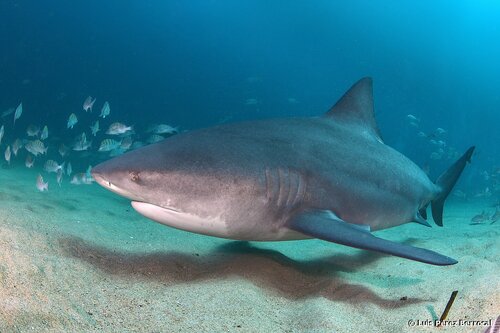
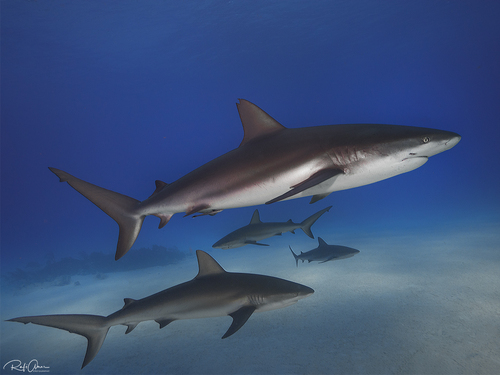
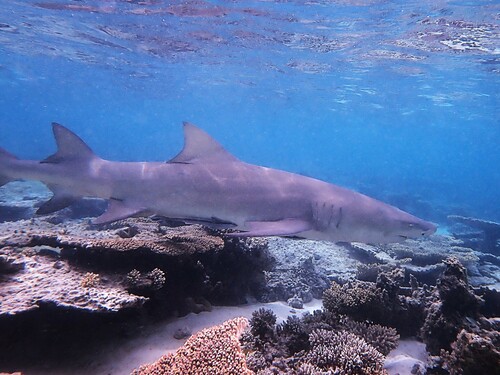
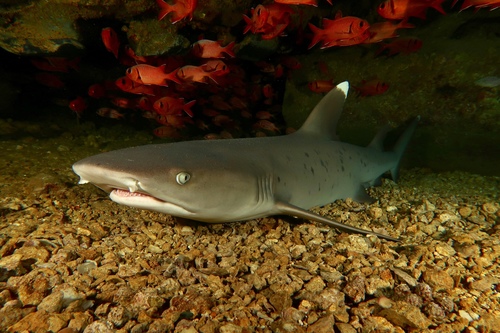
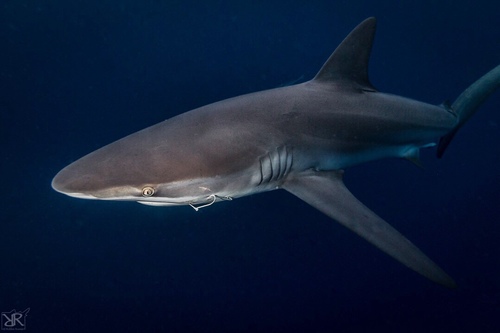
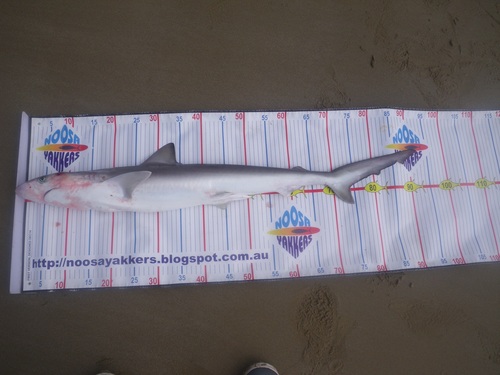
Rhizoprionodon acutus, commonly known as the milk shark, is the largest species in its genus. Off the coast of West Africa, male milk sharks have been reported to reach 1.78 m (5.8 ft) in length and 22 kg (49 lb) in weight, while females have been reported to reach 1.65 m (5.4 ft) and 17 kg (37 lb). However, there is uncertainty about the species identity of these specimens. Even if these measurements are accepted, they are considered exceptional, and most individual milk sharks do not exceed 1.1 m (3.6 ft) in length. On average, females are heavier and grow to a larger maximum size than males. The milk shark has a slender body with a long, pointed snout, large round eyes that have nictitating membranes (protective third eyelids), and no spiracles. On each side of the head, behind the corner of the jaw, there are usually 7 to 15 enlarged pores. Its nostrils are small, and the adjacent triangular skin flaps are also small. There are long furrows at the corners of the mouth on both the upper and lower jaws. Both jaws have 24 to 25 tooth rows. The upper teeth are finely serrated and strongly oblique; the lower teeth have a similar shape, but with smaller serrations and tips that curve gently upward. Juvenile milk sharks have smooth-edged teeth. The broad, triangular pectoral fins start below the third or fourth gill slits, and are no longer than the front margin of the first dorsal fin. The anal fin is about twice as long as the second dorsal fin, and long ridges run in front of it. The first dorsal fin starts over the free rear tips of the pectoral fins, and the much smaller second dorsal fin starts over the last third of the anal fin base. There is no ridge connecting the two dorsal fins. The lower lobe of the caudal fin is well-developed, and the upper caudal fin lobe has a ventral notch near its tip. This shark is plain gray, brown-gray, or purple-gray on its upper side, and white on its underside. The leading edge of the first dorsal fin and the trailing edge of the caudal fin may be dark, while the trailing edges of the pectoral fins may be light. The milk shark has the widest distribution of any species in the genus Rhizoprionodon. In the eastern Atlantic Ocean, it is found from Mauritania to Angola, as well as around Madeira. Since 1985, there have been four separate temporal and spatial records of milk sharks in the central Mediterranean Sea, and the species most likely entered this area through the Strait of Gibraltar. In the Indian Ocean, it occurs from South Africa and Madagascar northward to the Arabian Peninsula, and eastward to South and Southeast Asia. In the Pacific Ocean, this species occurs from China and southern Japan, through the Philippines and Indonesia, to New Guinea and northern Australia. The milk shark likely once had a contiguous distribution connected by the Tethys Sea. During the Miocene epoch, the collision of Asia and Africa isolated eastern Atlantic milk shark populations from Indo-Pacific populations. The milk shark lives close to shore, ranging from the surf zone down to a depth of 200 m (660 ft). It favors turbid water off sandy beaches and occasionally enters estuaries. In Shark Bay, Western Australia, juvenile milk sharks live in seagrass meadows made up of Amphibolis antarctica and Posidonia australis. Although some sources claim this species avoids low salinities, it has been recorded multiple times in fresh water in Cambodia, as far upstream as the Tonlé Sap. Milk sharks can be found anywhere in the water column, from the surface to the seafloor. Off KwaZulu-Natal, South Africa, the species' population numbers fluctuate annually and peak in summer, which suggests some form of seasonal movement. It is one of the most abundant, if not the most abundant, near-shore shark species across its range. The milk shark feeds mainly on small benthic and schooling bony fishes. It occasionally also preys on squid, octopus, cuttlefish, crabs, shrimp, and gastropods. In Shark Bay, the most important prey for this species are silversides, herring, smelt-whitings, and wrasses; it is also the only local shark species that preys on the Waigeo seaperch (Psammoperca waigiensis), which lives in seagrass beds that other sharks avoid. In the Gulf of Carpentaria, it feeds mainly on halfbeaks, herring, and mullets, and is also a major predator of penaeid prawns. Smaller milk sharks eat proportionally more cephalopods and crustaceans, and switch to eating more fish as they grow older. Many larger predators hunt the milk shark, including larger sharks such as the blacktip shark (Carcharhinus limbatus) and the Australian blacktip shark (Carcharhinus tilstoni), and possibly marine mammals as well. Off KwaZulu-Natal, the large-scale reduction of large shark populations caused by gillnet use for beach protection has led to a recent increase in milk shark numbers. A known parasite of the milk shark is the copepod Pseudopandarus australis. There is some evidence that male and female milk sharks segregate from each other.