About Rhizopogon roseolus (Corda) Th.Fr.
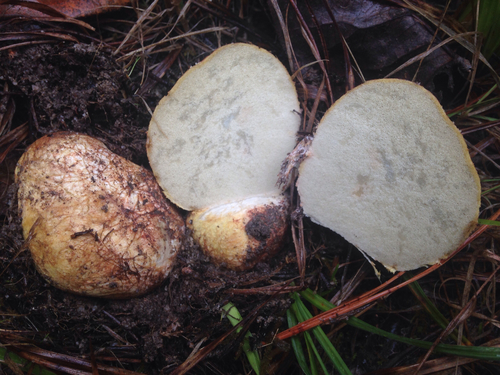
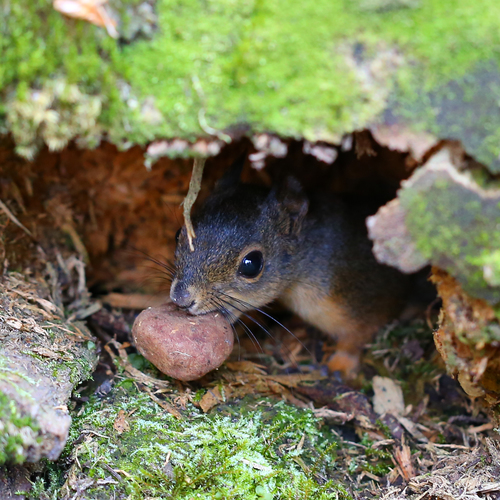
Rhizopogon roseolus (Corda) Th.Fr. produces fruiting bodies that are roughly spherical to elongated, and often pear-shaped. Dried specimens reach up to 3 centimetres (1+1⁄4 in) in diameter. The fruiting bodies start out white, and quickly change color to pink, reddish-brown, or sometimes a delicate violet-pink. Root-like strands of mycelium grow at the base of each fruiting body, and the fungus gives off a faint odor. Numerous fine, elastic fibrils or veins, which are not prominent, share the same color as the peridium or are darker than it. The single-layered peridium measures 240–400 μm thick. The gleba starts out white, and turns yellowish when it dries out. Small internal cavities are labyrinthine, and are either empty or filled with spores. These cavities are formed by transparent, branched hyaline hyphae. The basidia are club-shaped and hyaline, and measure 12–13 by 9–10 μm. Sterigmata are the same length as the spores. The spores of Rhizopogon roseolus have a unique color, ranging to ocher-tawny; they are smooth, ellipsoidal, and measure 7–16 by 3–5 μm. Because basidia of this species have lost the ability to actively eject spores, spores are dispersed by three main routes: rainwater washing away fragments of mature, viscous fruiting bodies, insects, and other animals. Rhizopogon roseolus is considered a cosmopolitan species, naturally distributed in Europe, North America, and northeastern Asia. It has also been artificially introduced to New Zealand as an edible fungus. This fungus forms ectomycorrhizae to live with pine trees. It shares characteristics with pioneer plants, and often appears when typical pioneer plants colonize areas that have experienced severe disturbance. In Europe, it grows under Pinus nigra on calcareous soil, and produces fruiting bodies from August to November. In Japan, it grows under pine species including Pinus densiflora and Pinus thunbergii, and has been recorded in Honshu, Shikoku, and Kyushu. This species has a bipolar mating system. Rhizopogon roseolus is considered a delicacy in Japan, where it is called shōro. Immature fruiting bodies that are still pure white on the inside are considered the highest quality, and are commonly known as komeshōro (米松露/コメショウロ). After being thoroughly washed in diluted salt solution to remove debris, it is typically cooked as a vegetable, used in soup, grilled with salt, and added as an ingredient to chawanmushi. Commercial cultivation techniques for this fungus in pine plantations have been developed and successfully applied in Japan and New Zealand. The fungus is also used as a soil inoculant in agriculture and horticulture.