About Rhizocarpon lecanorinum Anders
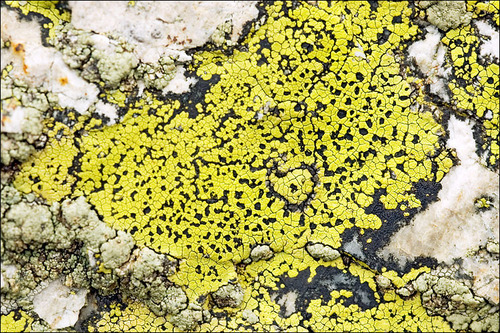
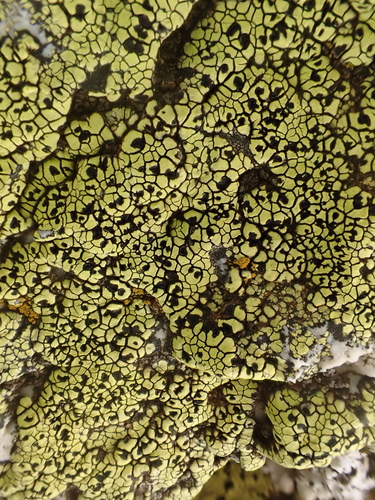
Rhizocarpon lecanorinum Anders forms a bright yellow-green crust that reaches around 4 cm across; neighboring thalli of this species often merge to form large, continuous patches. The crust surface is split into small, tile-like areoles 1–2 mm in diameter, which are matte and smooth. These areoles sit on a distinct black prothallus, a narrow border made of fungal tissue. Young areoles are rounded and slightly convex. As black fruiting discs called apothecia develop next to areoles, the areoles curve around the discs, giving the apothecia a rim of yellow thallus, which is referred to as a pseudo-lecanorine margin. The internal white tissue layer (the medulla) produces a blue iodine-positive reaction (I+ blue). The apothecia are small, reaching up to around 1 mm across, black, not frosted (non-pruinose), broadly circular, and range from flat to shallowly concave. The proper apothecia margin (the exciple) persists, but is often thin and indistinct; its inner section is colourless, while its outer rim is brown-black and does not react to potassium hydroxide solution (K–). The upper hymenial surface (the epithecium) is pale olive-brown and may turn greener when exposed to potassium hydroxide. The spore-bearing layer (the hymenium) is colourless to faintly green, and the layer below the hymenium (the hypothecium) is thin, brown-black, and K–, with no crystals present in the apothecia. Ascospores are dark brown and muriform, meaning they are partitioned into many small chambers like brickwork. They measure 34–57 × 15–24 μm, with approximately 15–38 cells visible when viewed in optical section. Spot tests on the medulla give K+ (yellow) and Pd+ (orange) results, showing the presence of stictic acid (often in low concentration) along with rhizocarpic acid. Field studies comparing Rhizocarpon lecanorinum to the map lichen R. geographicum found that neighboring R. lecanorinum thalli commonly merge without leaving visible boundaries, creating continuous carpets of areoles. In contrast, R. geographicum thalli (especially the subspecies prospectans) stay sharply separated from each other and form a mosaic. The merging growth habit of R. lecanorinum has been interpreted as evidence of somatic compatibility between very closely related or even clonal individuals, while the mosaic pattern in R. geographicum aligns with somatic incompatibility between distinct genotypes. In the same comparisons, R. geographicum usually produced many pycnidia, while R. lecanorinum had few pycnidia, but developed apothecia even when thalli were small and colony density was high. A facultative parasitic relationship has been recorded where Schaereria fuscocinerea invades R. lecanorinum thalli, spreads outward through the host, and replaces the host's cortex and algal layer with its own tissues; co-occurring R. geographicum resisted this invasion. Occasional parasitism of R. lecanorinum by Protoparmelia badia has also been observed. Ascospore release in Rhizocarpon lecanorinum is seasonal. Full-year field monitoring found a clear maximum of sexually produced ascospore discharge from late winter to spring. Apothecia typically mature over winter, which matches the timing of this spring peak. The observed pattern was not explained by any single weather factor; instead, alternating wet and dry conditions appeared to promote spore release. Spores were captured both individually and in clumps, and occasionally entire spore sacs (asci) were caught; splash dispersal may also contribute to what is captured during sampling.