About Rhizocarpon geographicum (L.) DC.
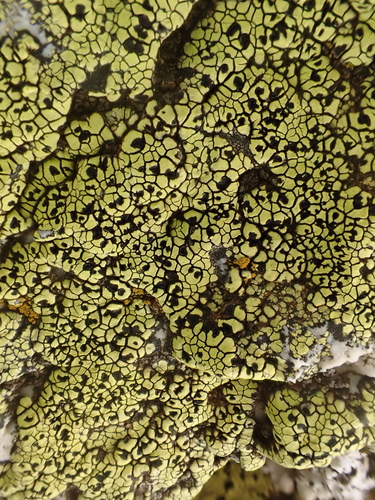
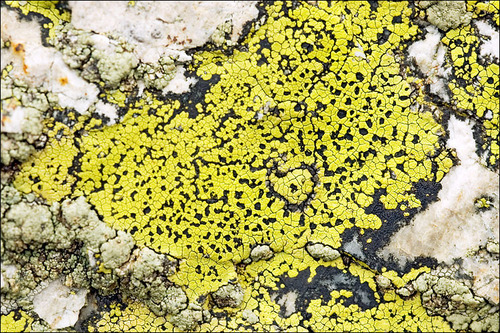
The thallus of Rhizocarpon geographicum forms extensive patches up to around 15 cm across. It is typically sharply defined by a well-developed black prothallus; inside this boundary, the thallus surface is split into small angular areoles. These areoles usually measure 0.2–1.8 mm across, occasionally reaching up to 2.5 mm. Their colour ranges from pale to vivid yellow-green, and some montane populations may have a faint orange tint. Areoles are usually tightly packed, though they can be more sparsely scattered across the black prothallus layer. Their surface ranges from flat to gently convex, more rarely slightly concave, and is generally smooth. The internal white medulla stains blue with iodine, which confirms the presence of amyloid polysaccharides. The species' sexual structures are small black apothecia, usually less than 1.5 mm in diameter, that grow on the areoles and are round to somewhat angular. The apothecia discs are flat to slightly convex, have no surface pruina, and are surrounded by a margin that ranges from thick to only weakly developed. In cross-section, the outer rim of the exciple is dark brown, while the inner part is paler and typically turns purple-red when exposed to potassium hydroxide solution. The uppermost tissue, the epithecium, is red-brown, brown, or olive-green. The ascospores are dark brown, muriform, and relatively large, measuring roughly 20–50 × 10–20 μm, with many internal cells visible in optical section. The medulla usually gives a Pd+ yellow reaction, indicating it contains rhizocarpic acid, plus either psoromic acid or barbatic acid. Some chemotypes do not show this reaction, or contain other minor substances such as bourgeanic acid or low amounts of gyrophoric acid. This lichen species has a broad distribution, and can be found in most cold regions with exposed rock surfaces. In North America, its range includes the Sierra Nevada and the northern boreal forests of Canada; it also occurs in Greenland, Iceland, Fennoscandia, and Siberia. In the tropics, it only grows at high altitudes, for example in the Andes of Peru and Colombia. Further south, the map lichen is widespread across Patagonia, and also occurs in the Falkland Islands, sub-Antarctic islands, and the Antarctic Peninsula. In Britain, it is commonly found growing on hard siliceous rocks, particularly in upland regions. Its range covers almost all of Scotland, most of northwest England, and other upland areas across most of the rest of England, Wales, and Ireland. In Spain, it occurs primarily in siliceous mountain ranges, though it can occasionally be found near sea level even in southern Spain, where it has been recorded at Cabo de Gata. Ecologically, Rhizocarpon geographicum is a known host for the lichenicolous fungus species Muellerella pygmaea.