About Rhithropanopeus harrisii (Gould, 1841)
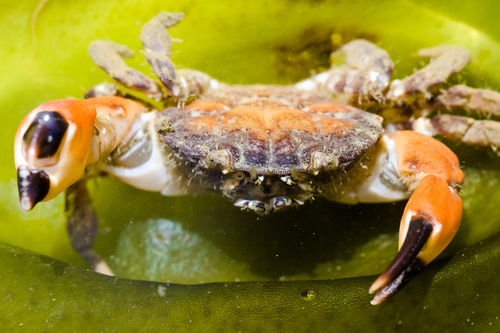
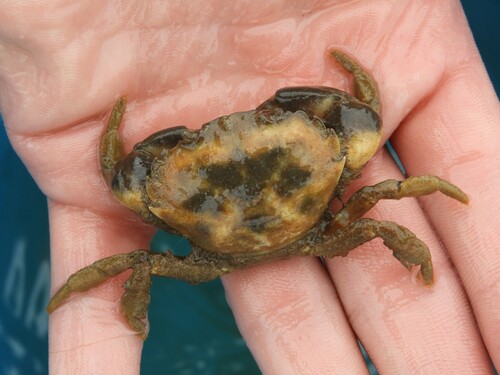
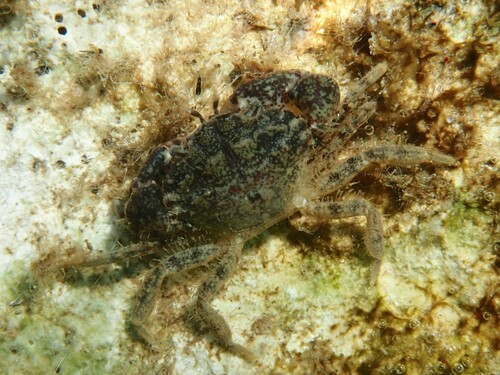
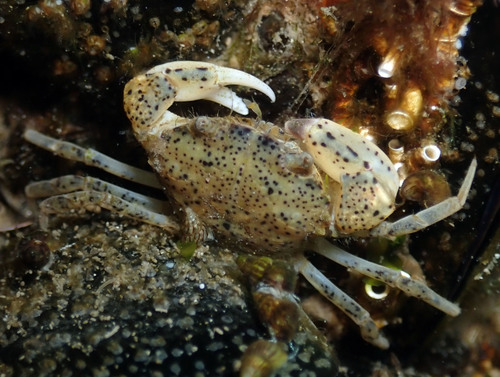
Rhithropanopeus harrisii has several common names: Zuiderzee crab, dwarf crab, estuarine mud crab, Harris mud crab, white-fingered mud crab, and white-tipped mud crab. It is a small omnivorous crab native to the Atlantic coasts of the Americas, ranging from New Brunswick to Veracruz. R. harrisii is most commonly found in brackish water, but it can also live in freshwater. It prefers habitats on stones and within oyster beds. This crab can reach a maximum size of 20 millimetres (0.8 in). Its typical coloration is olive-green-brownish, and it sometimes has dark spots on its carapace. It is a common native resident of Texas and Florida estuaries, but has since been introduced to locations across the globe. In 1937, it was found invading the brackish waters of San Francisco Bay and the adjacent fresh waters of California’s Central Valley. It was also recently discovered in Third Lock Lake, Panama, a man-made lake that is part of the Panama Canal. R. harrisii was first recorded in Europe in the Zuider Zee, Netherlands, and is now also found in Denmark, Belgium, Germany, France, Poland, Estonia, Finland, Russia, Portugal, Spain, Italy, Romania, Bulgaria, the Black Sea, and the Caspian Sea. In the British Isles, R. harrisii has only been observed in Roath Docks, Cardiff, where salinity is lower (12‰) than in the surrounding waters. Breeding populations that live in freshwater have been found in the Brazos River basin in Texas, specifically in Possum Kingdom State Park and Lake Granbury. Populations have also been found in Lake Texoma and Lake E.V. Spence. Its presence in the Baltic Sea has been linked to a negative shift in the local ecosystem. One record of this species from Brazil exists, but it may be a misidentification.