About Rhipidura rufifrons (Latham, 1802)
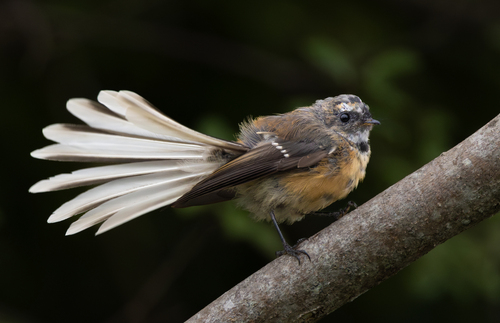
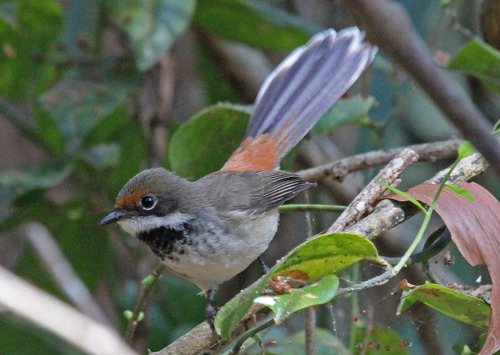
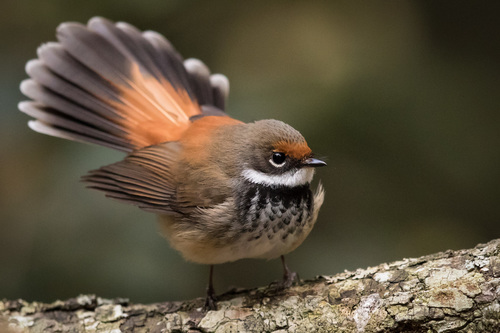
Adults of Rhipidura rufifrons, also called the Australian rufous fantail, are medium-sized birds, generally 14.5 cm to 18.5 cm long, averaging around 15 cm. Their wingspan ranges from 18 cm to 22.5 cm, averaging around 21 cm, and they weigh roughly 10 grams. Males and females have identical appearance, though females are generally smaller than males. This species has a rich reddish-brown forehead that extends across the eyes, with a white arc just below each eye. The top of the head, back of the neck, and upper back transition from olive to reddish-brown, which then blends into a long, fan-shaped blackish-brown tail. The blackish-brown main tail contrasts with the paler, often white, tips at the base of the tail. It has black ear-coverts, the feathers covering the ears just below and behind the eyes. In most subspecies, the throat is white, and a black bar stretches across the upper breast. Below this bar, the lower breast is off-white with black scale-like spots, which transitions to an off-white color toward the center of the abdomen. The eyes, bill, and feet of the bird are all brown. These established plumage colors do not change with the seasons. Compared to adults, juvenile birds have generally duller-colored backs, marginally browner tails and underparts, and paler brown bill base and legs than adults. Immature birds of both sexes have plumage similar to that of adults. Adults moult annually before the breeding season, and their resulting basic plumage does not vary. Physical details to distinguish different subspecies can be found in the subspecies section of the source article. The Australian rufous fantail can be found in parts of Australia, southeast Asia, and the Oceanic regions of Micronesia and Melanesia. It is resident in the Lesser Sunda Islands and the Maluku Islands of Indonesia, southern New Guinea and its associated islands, the Solomon Islands, the Marianas, and the Carolinian island of Yap. In Australia, it occurs in the northern and eastern coastal regions. Certain subspecies are restricted to specific ranges, and more detailed information can be found in the subspecies section of the source article. The Australian rufous fantail inhabits moist, moderately dense habitats, and shows remarkably large variation in habitat requirements across its range. It can be found in eucalyptus forests, mangroves, rainforests, and woodlands, usually located near a river or swamp. It has rarely been found even in dry sclerophyll forests. With the exception of open grasslands and open arid areas, there are few major landscape types in the Australo-Papuan region that cannot host at least one subspecies of this bird. Australian rufous fantails generally occupy the lower levels of their habitat, the understorey or subcanopy, and rarely go higher than 6 m above the ground. Different subspecies may prefer slightly different habitats, which are sometimes discrete and sometimes overlapping. Studies on the social behaviour of the Australian rufous fantail are limited. Some observers have anecdotally described the species as curious and trustful, while others describe it as shy. There is universal consensus that the species is almost always hyperactive: it is constantly moving, fidgeting, and waving its fanned-out tail. It is usually observed flitting through the lower layers of its habitat, staying close to shade, making short frequent flights separated by brief moments of perching, and sometimes hopping between foliage or onto the ground. Australian rufous fantails eat mostly small insects, and will often join mixed-species feeding flocks with other small Passerine birds, most commonly the spectacled monarch, the little shrikethrush, and the large-billed scrubwren, and less commonly the green-backed honeyeater. The Australian rufous fantail is mostly an aerial forager, and rarely perches while feeding. It searches for prey while moving almost continuously through and between patches of vegetation. It stops to perch for very short periods, during which it fans its tail. Much more rarely, it perches for longer than five seconds to survey its surroundings. Once prey is located, the fantail pursues it with extremely agile, maneuverable flight within the canopy, using techniques such as salling, flush-pursuit, or flutter-chase. The species is a versatile forager, and is also capable of using other foraging methods: it occasionally hovers to glean prey from leaves, and very rarely gleans prey from the ground and other fallen debris. It has longer legs relative to other Rhipidura species, which allows it to move agilely on the ground as well.