About Rhipidura leucophrys (Latham, 1802)
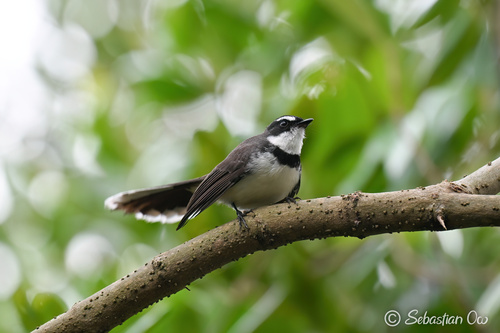
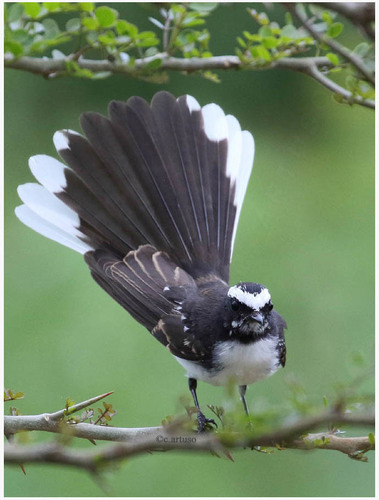
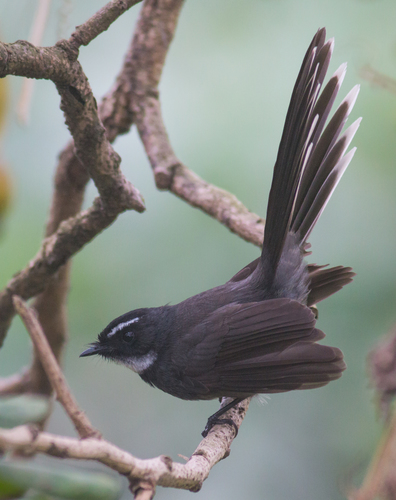
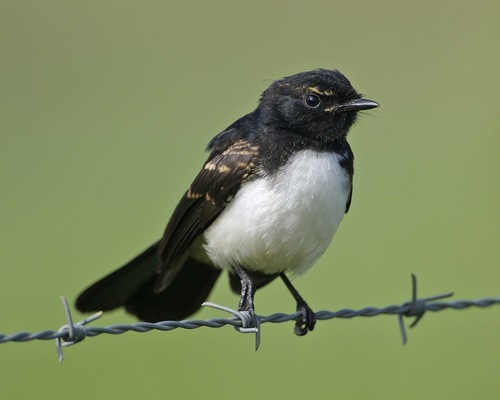
An adult willie wagtail (Rhipidura leucophrys) measures 19 to 21.5 cm (7.5 to 8.5 in) in total length, weighs 17–24 g (0.6–0.85 oz), and has a tail 10–11 cm (approximately 4 in) long. Its short, slender bill is 1.64–1.93 cm (around 0.75 in) long and tipped with a small hook. This species has longer legs than other fantails, which may be an adaptation for foraging on the ground. Males and females have similar plumage: the head, throat, upper breast, wings, upperparts, and tail are all black, with a white eyebrow, white "whiskers" and white underparts. The bill and legs are black, and the iris is dark brown. Immature birds in their first year, after moulting out of juvenile plumage, may have pale tips on their wings. Juvenile birds have duller overall plumage, with brown-tinged upperparts and pale brown scallops on the head and breast. The willie wagtail is widespread and abundant across most of Australia and New Guinea, the Solomon Islands, the Bismarck Archipelago, and eastern Indonesia. It stays in the same area year-round across most of Australia. Seasonal movements have been recorded in some areas: it is an autumn and winter visitor to northeastern New South Wales, southeast Queensland, the Gulf Country, and parts of Cape York Peninsula in Australia's far north. It is a vagrant to Tasmania, and occasionally reaches Lord Howe Island. There is a single record of the species from Mangere Island in the Chatham Islands archipelago east of New Zealand, documented in 2002. The willie wagtail was released in Hawaii around 1922 to control insects affecting livestock, but this introduction was unsuccessful, and the last confirmed sighting in Hawaii was at Koko Head in 1937. The willie wagtail can live in a wide variety of habitats, but avoids dense forested areas such as rainforest. It prefers semi-open woodland or grassland with scattered trees, and is often found near wetlands or bodies of water. In New Guinea, it inhabits man-made clearings, grasslands, open forest, and mangroves. On Guadalcanal, it has been recorded in open areas and coconut groves. It has adapted well to human-altered landscapes, and can often be seen hunting in open grassed areas such as lawns, gardens, parkland, and sporting grounds. After original vegetation was cleared for agriculture, the species spread into the Western Australian Wheatbelt.