About Rhipidura cyaniceps (Cassin, 1855)
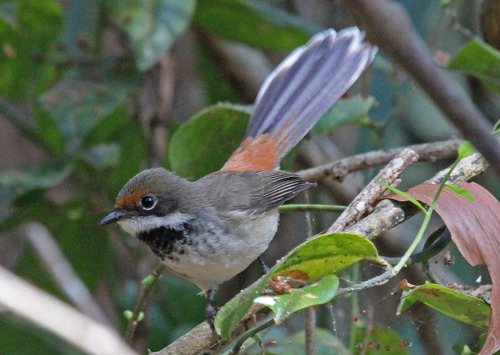
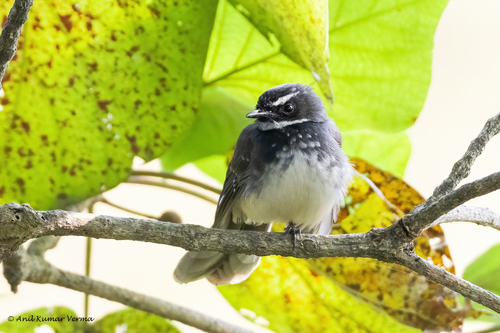
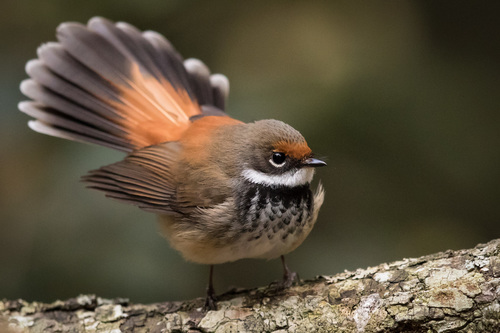
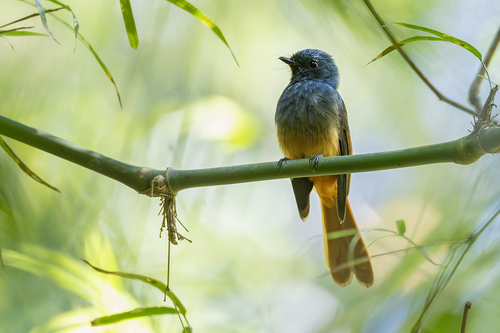
Rhipidura cyaniceps, first described by Cassin in 1855, is a medium-sized, long-tailed bird found in primary and secondary forest from the lowlands to the mountains on Luzon and Catanduanes. It has dull blue plumage on the head, chest, back, and shoulder, with paler blue streaking on the chest and crown. Its belly is buff, while the lower back, rump, outer tail feathers, and wing are rufous; it also has dark central tail feathers and a dark edge to the wing. When foraging, it often holds its tail cocked and fanned open. It is similar in appearance to the Black-naped Monarch, but differs by having a rufous rump and tail. Its voice is made up of single sharp "pik!" notes given at intervals, or these notes can be sped up into a rapid series. This species forms a species complex with the Tablas fantail and Visayan fantail, and is distinguished from the other members of the complex by molecular studies, voice, a solid blue chest with no shaft streaks, and a brown belly. Its natural habitats are tropical moist lowland forest and tropical moist montane forest up to 2,000 meters above sea level. It can be found in a wide range of forest types, including lowland Dipterocarpus forests, and montane pine, oak, and laurel forest. The IUCN Red List has classified this species as Least Concern. It is locally common, and its population is believed to be stable, due to its general adaptability and tolerance for degraded forest. It occurs in multiple protected areas, including Mount Banahaw, Mount Makiling, Mount Isarog, Bataan National Park, and Northern Sierra Madre Natural Park. However, like all protected areas in the Philippines, enforcement of protection is lax, and deforestation and hunting continue despite the species’ formal protected status on paper. This fantail forages in the understory for insects, and often joins mixed-species foraging flocks that include Golden-crowned babbler, Lemon-throated leaf warbler, Black-crowned babbler, Little pied flycatcher, Turquoise flycatcher, Negros leaf warbler, and other small birds. Little detailed breeding information is known for this species, but its breeding season is believed to run from February to May, which aligns with the breeding season of most other Philippine forest birds.