About Rhipicephalus sanguineus Latreille, 1806
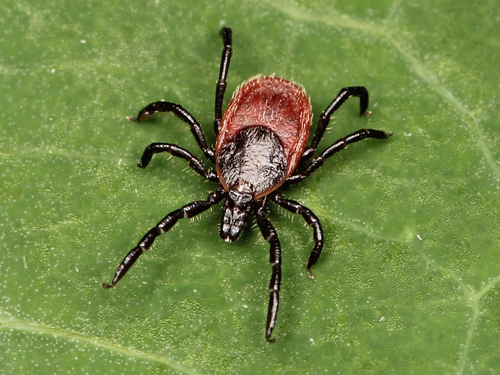
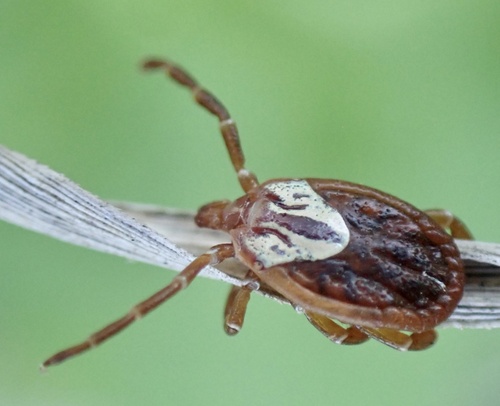
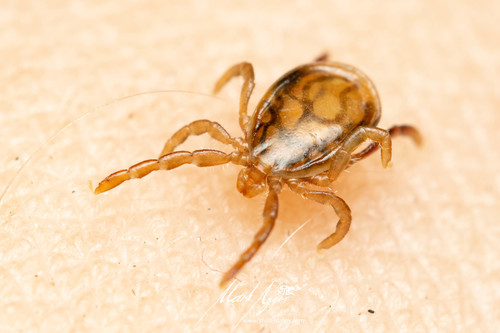
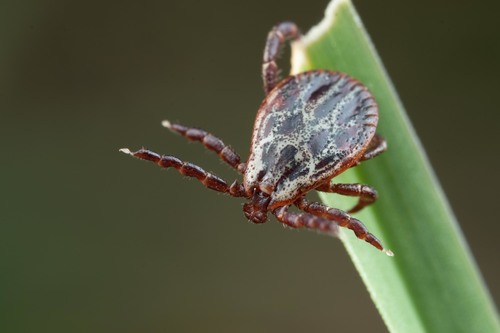
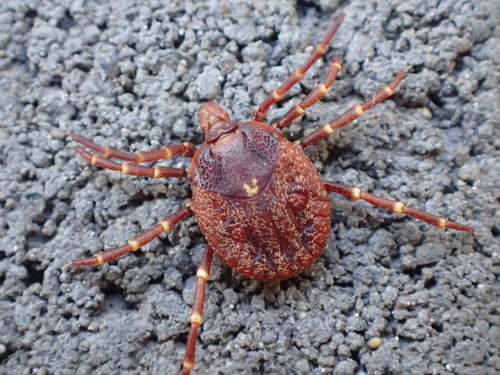
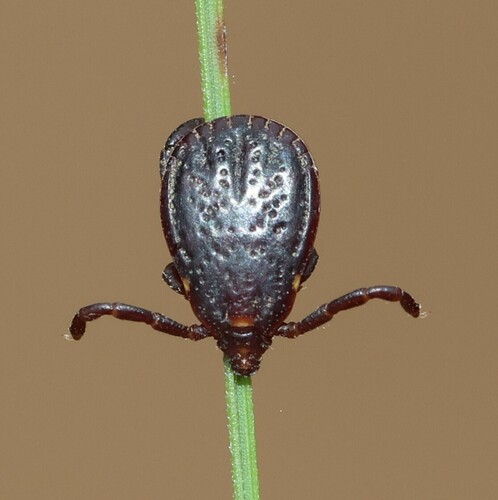
Rhipicephalus sanguineus, commonly known as the brown dog tick, kennel tick, or pantropical dog tick, is a tick species found around the world, and is more common in warmer climates. Unlike most other tick species, R. sanguineus can complete its full lifecycle indoors. This tick can be easily identified by its reddish-brown color, elongated body shape, and hexagonal basis capituli, the flat surface where mouthparts attach. Adult brown dog ticks measure 2.28 to 3.18 mm in length and 1.11 to 1.68 mm in width, and have no ornamentation on their backs. As a cosmopolitan species, R. sanguineus occurs worldwide, except in the United Kingdom, where as of 2001 and 2002 studies it was only found in quarantine kennels; no established populations outside these quarantine areas had been detected in the UK as of 2010. Due to global warming, the species' distribution is shifting: for example, locally transmitted (autochthonous) cases have emerged and increased in Hungary starting in 2005. Rhipicephalus sanguineus is counted among the most important vectors of diseases affecting dogs globally. In the United States, it carries multiple disease-causing pathogens that infect dogs, including Ehrlichia canis (the pathogen that causes canine ehrlichiosis) and Babesia canis (the pathogen responsible for canine babesiosis). In infected dogs, canine ehrlichiosis causes symptoms including lameness and fever, while babesiosis causes symptoms including fever, anorexia, and anemia. There is no evidence that R. sanguineus can transmit the bacteria that cause Lyme disease to humans. In regions of Europe, Asia, and Africa, this tick is a vector for Rickettsia conorii, the pathogen that causes Mediterranean spotted fever (also called boutonneuse fever or tick typhus). It can also transmit Rickettsia rickettsii, the bacteria that causes Rocky Mountain spotted fever in humans living in the Southwestern United States.