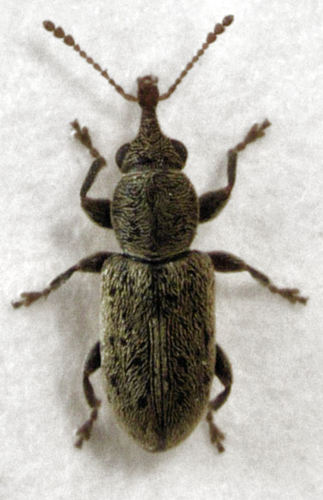
About Rhinorhynchus rufulus
Broun's original species description of Rhinorhynchus rufulus reads as follows: The species is rufous, moderately shining, and pilose, with fulvous antennae and legs. Antennae are inserted at the middle of the rostrum, are moderately stout, eight-jointed, with a three-jointed club. The two basal joints are nearly equal in length, and together are nearly half as long as the rest of the antenna combined. The third and fourth joints are elongate, each a little shorter than the fifth. The sixth to eighth joints are about equal in size. The club is loosely articulated; its basal joint is somewhat cup-shaped, and its second joint is the largest, sub-quadrate, and apical. The rostrum is rather slender, elongate, somewhat deflexed and arcuated, and extends from the lower part of the head. Its basal half is narrow and cylindrical, a little thickened near the eyes, and its apical half is abruptly (but not greatly) dilated. Mandibles are prominent; the rostrum is a shining rufous color, and completely hairless. The head is punctate, nearly as broad as the thorax, short, and deflexed at the front. Eyes are moderately large and prominent, and nearly circular. The thorax is oviform, longer than broad, with regularly rounded sides, a sub-truncate base, and a finely punctured disc. Elytra are oblong, wider than the thorax, somewhat emarginated at the base, with obtuse shoulders. The sides are nearly parallel and rounded at the apex. The disc has a subdepressed appearance due to slight basal and posterior elevations; elytra are punctate but not noticeably striated. Legs are moderately long; femora are inflated, tibiae are straight and not spined. Tarsi are stout; the basal joint is obconical, more slender but rather longer than the triangular second joint. The penultimate joint is bilobed, and the apical joint is elongate. The scutellum is small and somewhat transverse. The body is covered with sub-depressed stiff fulvous hairs, while legs and antennae are nearly hairless. The fifth joint of the antenna is obconical and stouter than the other joints. Kuschel noted that Broun's original description was based on a female specimen of the species. Rhinorhynchus rufulus is endemic to New Zealand. It can be found on the North Island, South Island, and Stewart Island, ranging from sub-alpine altitudes down to sea level. This weevil's host plants are conifer species belonging to the genera Phyllocladus, Dacrycarpus, Dacrydium, Halocarpus, Lepidothamnus, Manoao, Podocarpus, and Prumnopitys. It is most commonly found on the conifer species Podocarpus nivalis and Lepidothamnus laxifolius.

