About Rhinoptera bonasus (Mitchill, 1815)
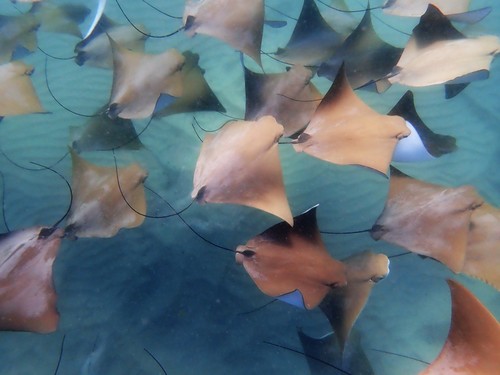
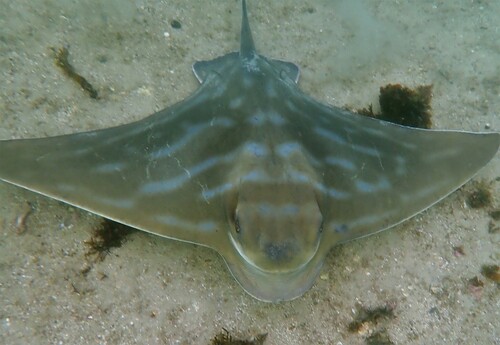
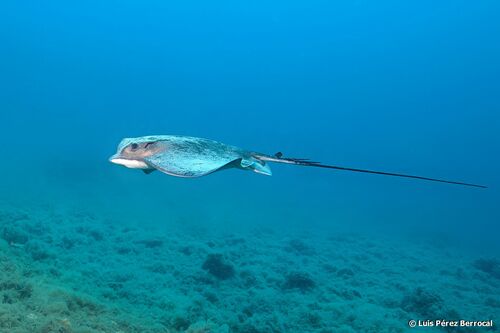
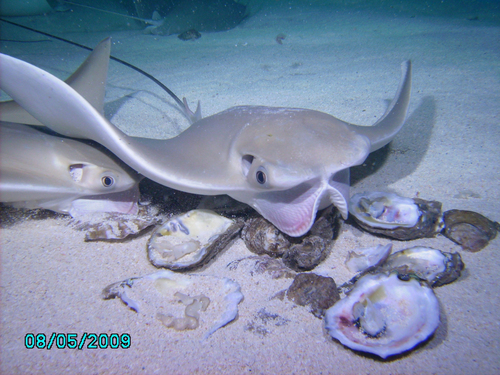
This is the species description for Rhinoptera bonasus (Mitchill, 1815), commonly known as the cownose ray. A cownose ray typically has a brown back with a slightly white or yellow belly. While its coloration is not particularly distinctive, its shape is easily recognizable. It has a broad head with wide-set eyes, and a pair of distinctive lobes on its subrostral fin. It also has a set of dental plates adapted for crushing clam and oyster shells. Male cownose rays often reach about 2.5 feet (0.76 m) in width, while females typically reach about 3.0 ft (0.9 m) in width. Beach-goers sometimes mistake cownose rays for sharks, because the tips of the rays' fins stick out of the water and often resemble a shark's dorsal fin. When threatened, the cownose ray can use the barb at the base of its tail to defend itself. It has a venomous spine close to its body; this spine has teeth along its lateral edges, and is coated with weak venom that causes symptoms similar to a bee sting. Cownose rays are migratory, social creatures found along the East Coast of the United States, in the Gulf of Mexico, and in Brazil. They prefer to live in nearshore coastal waters and estuarine ecosystems, and can tolerate a wide range of salinities. Cownose rays may change habitats if an area becomes too crowded and resource competition is high. They are known to be abundant in Chesapeake Bay, where they migrate for mating and nursery purposes, typically during late spring and summer, and are usually spotted near the water surface. Cownose rays breed from April through October. They do not reach sexual maturity until they are roughly 70% of their maximum size. Females reach maturity between 7 and 8 years of age, while males reach maturity around 6 to 7 years of age. Cownose ray lifespan varies by sex; the oldest recorded female was 21 years old, and the oldest recorded male was 18 years old, both observed in Chesapeake Bay. Cownose rays are ovoviviparous, meaning embryos grow inside the mother until they are ready to hatch. As a K-selected species, cownose rays have a longer gestation period, which is thought to last between 11 and 12 months. At full term, the offspring are born live, exiting tail first.