About Rhinopomastus minor (Rüppell, 1845)
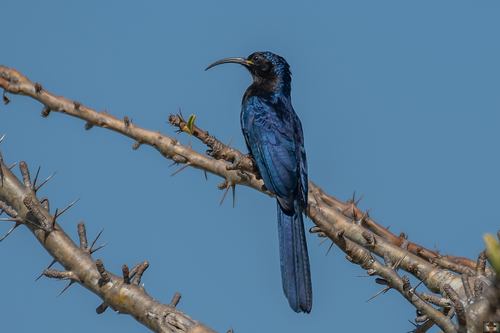
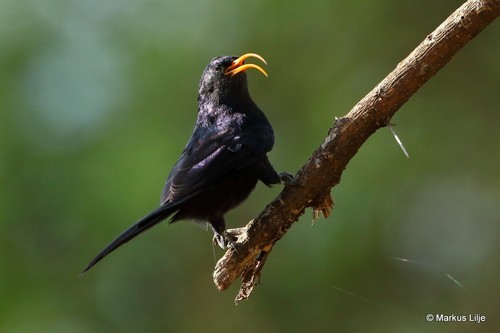
Rhinopomastus minor (Rüppell, 1845) is a bird species with entirely black plumage covered in blue-purple iridescence that is most prominent on the back of the head. Its beak ranges from bright orange to red, and is characteristically curved, pointed, and slightly longer than the length of its head. This beak shape is adapted for probing cracks and crevices to find insects. It can be distinguished from other wood hoopoes by its all black legs and shorter tail, which matches the length of the bird’s body when the head is excluded. This species is most commonly found in open bushy dry savanna habitats. It is an uncommon resident in thorn scrub habitats at low altitudes below 1400 meters; thorn scrub is an intermediate biome between desert and tropical forest. Two subspecies occupy separate ranges across Africa: Rhinopomastus minor minor occurs along the eastern edge of the continent from Ethiopia to Somalia and Kenya, while Rhinopomastus minor cabsanisi occurs further west, from Sudan to Ethiopia, Kenya, and Tanzania. The species’ breeding range centers around the equator, spanning between -9.01 and 11.78 degrees latitude. Its total territorial range covers approximately 20,000 square kilometers, though this range is heavily fragmented. Though the population is declining, the decline rate is only 5% across three generations, so the species is classified as least concern. This bird is a monogamous solitary nester. Individuals first breed at an average age of 1.23 years, and average clutch size is 2 eggs. Adult annual survival rate is 0.66, and average generation length is 2.89 years. Nests are typically built in holes or fissures, which are sometimes excavated by other species. Nest sites include tree holes and occasionally abandoned beehives, placed around 0.5 to 2 meters above the ground. The cabanisi subspecies has a strong preference for breeding during the dry season.