About Rhinopithecus bieti A.Milne-Edwards, 1897
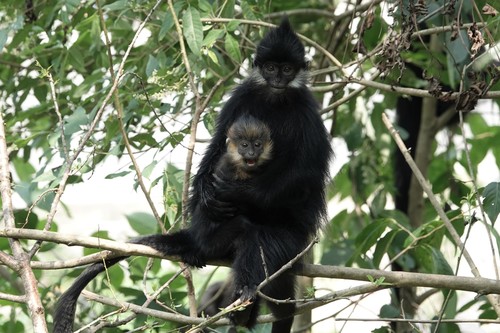
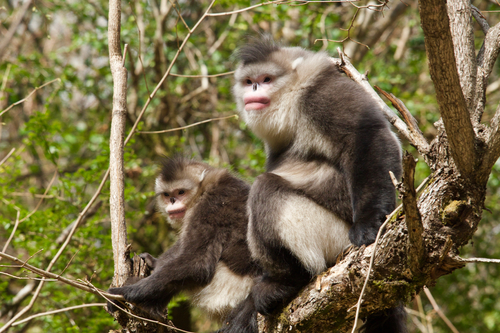
The black-and-white snub-nosed monkey (Rhinopithecus bieti), also called the Yunnan snub-nosed monkey, is a large black-and-white primate that lives only in the southern Chinese province of Yunnan. Local people know this species as the Yunnan golden hair monkey (Chinese: 滇金丝猴) and the black-and-white snub-nosed monkey (黑白仰鼻猴). Note that the common name "black snub-nosed monkey" refers instead to Rhinopithecus strykeri, a species that lives on the northern Sino-Myanmar border. This primate favors mountainous coniferous and deciduous forests in Yunnan as its habitat. It has unique environmental adaptations that let it thrive at extreme altitudes, even with below-freezing temperatures and thin air. Its diet consists mainly of the abundant lichens found in its native region. This species is threatened by habitat loss and is classified as endangered. This species has a highly restricted distribution in the biodiverse Nujiang Lancang Gorge alpine conifer and mixed forests of the Yun Range, which is part of the larger Hengduan Mountains. Only 17 groups with a total population of fewer than 1,700 individuals survive in northwest Yunnan and adjacent regions in the Autonomous Prefecture of Tibet. Each group occupies a home range between 20 and 135 square kilometers. Deciduous and coniferous forests, where lichen grows abundantly year-round, are their preferred habitat. The reproductive cycles of black-and-white snub-nosed monkeys are generally similar to those of golden snub-nosed monkeys. However, births in this species typically occur two to three months later, due to its colder climate. Like most primates, this snub-nosed monkey gives birth at night, which makes births hard for researchers to observe. One rare observation of a daytime birth recorded that a multiparous female assisted another female during the birthing process, in a behavior similar to human midwifery.