About Rhinophrynus dorsalis Duméril & Bibron, 1841
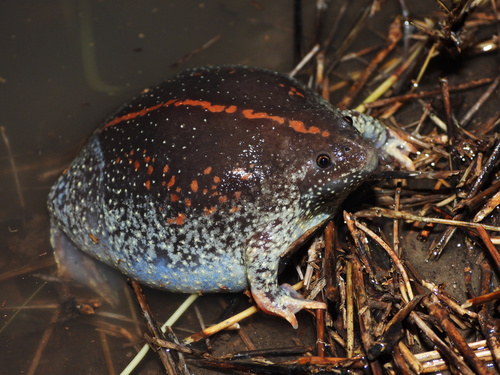
The Mexican burrowing toad (Rhinophrynus dorsalis) has a unique appearance that makes it easy to distinguish from other species. This species has a flat body, with its width and length being almost equal. Its body is covered in loosely fitting wrinkled skin, which becomes taut and shiny when the toad swells its body to produce a mating call. It has a small, triangular head that tapers to a small point, with very small eyes. It has no neck, and no visible ear holes or tympanum. Its legs are short and muscular, built for burrowing as the species' common name suggests. Its feet also have burrowing adaptations, most notably nail-like keratinized structures at the end of each digit. The front feet have no webbing between digits to keep them unobstructed for digging, while the back feet are short and heavily webbed. The toad's base color ranges from dark brown to black. A bright red-orange stripe runs along its back from head to the end of the body, and the rest of the body is covered with other red-orange splotches in varying patterns. Its underside is gray to dark brown, and does not have the red splotches found on the rest of the body. This toad is sexually dimorphic: females are larger than males. Adult Mexican burrowing toads reach a snout-vent length of 75 to 88 mm, or approximately 3.0 to 3.3 inches. The Mexican burrowing toad occurs in tropical and subtropical dry broadleaf forest, savannas, and thorn scrub (such as the Tamaulipan mezquital) in the lowlands of Central America, Mexico, and extreme south Texas, USA. It has one continuous population in the Lower Rio Grande Valley of south Texas, USA, that ranges south through the coastal lowlands of the Gulf of Mexico and Caribbean Sea in eastern Mexico (including most of the Yucatán Peninsula), into northern Guatemala, Belize, extreme northwest Honduras, with an isolated recorded occurrence in northeast Nicaragua. A second geographically isolated population lives on the Pacific coast lowlands, from extreme southern Michoacán, Mexico, southward into coastal areas of Guatemala, El Salvador, Nicaragua, Honduras, and northwest Costa Rica. Because it has a wide geographic range, the IUCN categorizes this species as Least Concern, but some local and regional populations are protected and listed as threatened by governments within its distribution. Its natural habitats include forest, savanna, shrubland, grassland, and inland wetlands. It primarily lives in lowland areas of tropical dry and moist forests. It is generally associated with seasonally flooded areas, as it relies on temporary ponds for breeding. It usually stays underground during the dry season that follows the breeding period. Its eggs and larvae develop in temporary pools formed by heavy rains, and adult toads remain in fairly small home ranges. This species has a characteristically short, explosive breeding period that often lasts only one to three days. This short breeding window, combined with the ecological conditions of dry seasonal forests, has shaped the evolution of the species' courtship behavior and male-female interactions. The species has size-based sexual dimorphism, with females larger than males, and male-male contests are almost entirely absent during the short breeding period. Because there is no male-male competition or territoriality, females choose mates based on the frequency and tonality of male advertisement calls. The characteristics of a male's advertisement call allow females to assess his size, and larger females prefer to mate with larger males over smaller ones.

