About Rhinolophus nippon Temminck, 1835
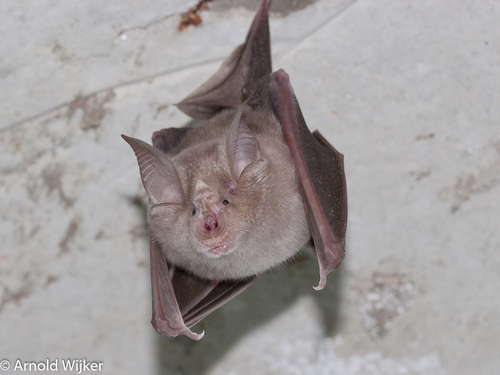
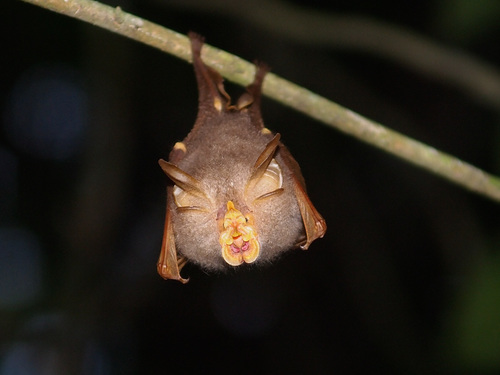
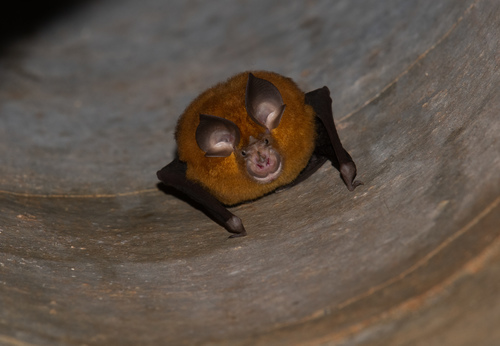
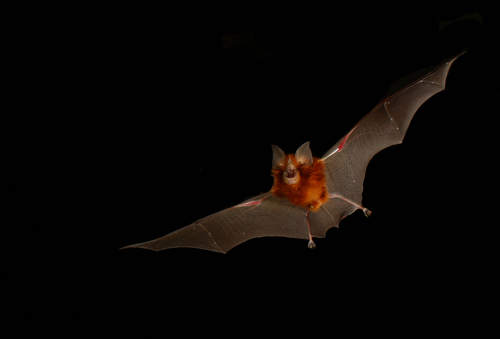
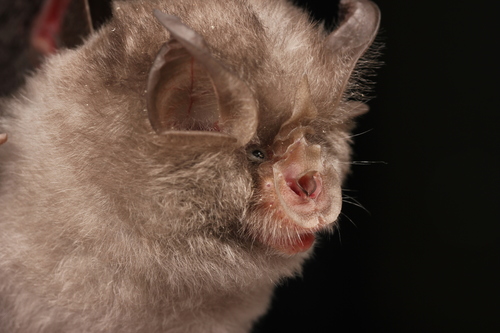
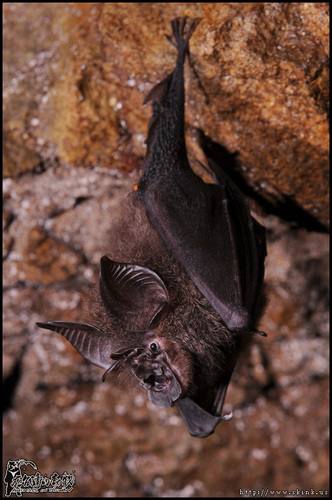
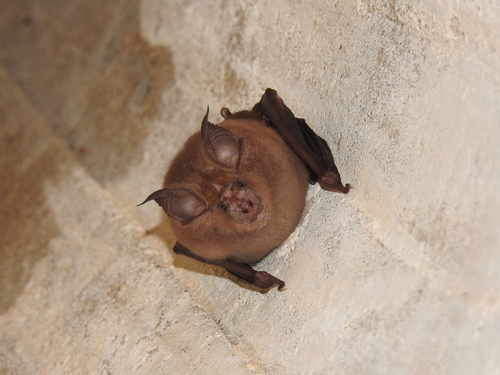
The greater horseshoe bat (Rhinolophus nippon Temminck, 1835, also referenced as Rhinolophus ferrumequinum) is the largest horseshoe bat found in Europe. It has a distinctive noseleaf, with a pointed upper portion and a horseshoe-shaped lower portion; this structure helps focus the ultrasound the bat uses to navigate and locate prey. This species has unique tooth and bone structures that set it apart from other rhinolophids. Its first upper premolar protrudes from the tooth row, while in other horseshoe bats, this premolar is very small or absent. Compared to its close relatives, the greater horseshoe bat has relatively short third and fourth metacarpal bones in its wings, and it lacks a tragus. On average, the greater horseshoe bat has a body length of 57–71 millimetres (2.2–2.8 in), a tail length of 35–43 mm (1.4–1.7 in), and a wingspan of 350–400 mm (14–16 in). This species shows slight sexual dimorphism, with females growing slightly larger than males. Its fur is soft and fluffy: the base of each hair is light grey, dorsal fur is grey brown, and ventral fur is grey-white. Juvenile bats have fur with a more pronounced ash-grey tint, and wing membranes and ears are light grey-brown. The greater horseshoe bat can weigh up to 30 grams (1.1 oz) and live up to 30 years. The greater horseshoe bat's distribution extends from North Africa and southern Europe through southwest Asia, the Caucasus, Iran, Afghanistan, Pakistan, and the Himalayas to southeastern China, Korea, and Japan. Its northernmost known population occurs in Wales, and its range reaches the southern parts of the Netherlands, Germany, Poland, and Ukraine. Most populations live below 800 m above sea level, but can be found up to 3,000 m asl in the Caucasus, depending on roost availability and humidity. Common foraging habitats for this species include pastures, deciduous temperate woodland, and Mediterranean and sub-Mediterranean shrubland and woodland. In the northern parts of its range, the greater horseshoe bat uses warm underground sites (both natural and artificial) as well as attics for summer roosts. When the species roosts in buildings, proximity to good foraging areas and underground sites for torpor at different times of year, for winter hibernation, and the building's own characteristics are important factors. Greater horseshoe bats hibernate in cold underground sites during winter, and they require specific ranges of temperature and humidity that vary by age, sex, and individual condition. In the southern parts of the species' range, bats are active year-round. Greater horseshoe bats commonly travel 20–30 km between their winter and summer roosts, and the longest recorded travel distance between roosts is 180 km. In South Asia, this species also lives in montane forests across Himalayan mountains and valleys, roosting in tight clusters in caves, old temples, and old or ruined buildings. Males become sexually mature at two years of age, while females reach sexual maturity at three, and some females do not breed until they are five years old. Most matings happen in the fall, though some matings occur in spring. The species' reproductive behaviour has been well studied: during the mating period, females visit males that roost in small caves. The mating system is most accurately described as polygynous, with multiple females visiting individual males. However, genetic evidence shows that some female greater horseshoe bats will visit and mate with the same male partner across multiple consecutive years, indicating monogamy or mate fidelity. Related females have also been found to share sexual partners, which may increase relatedness and social cohesiveness within the colony. Male reproductive success varies between individuals, with no strong reproductive skew observed within a single year. Over multiple years, however, reproductive skew becomes strong, because certain males achieve repeated mating success. After mating, seminal fluid coagulates in the female's vulva to form a plug, which likely functions either to prevent subsequent matings by other males, or to increase the chance that sperm are retained for successful fertilization. There is some evidence that females can eject these plugs, which suggests females may be able to exert some control over which fertilizations occur. Females raise their young in communal maternity roosts, and show strong fidelity to the sites where they were born, a trait called natal philopatry. Each breeding season, a female produces one offspring. Most young are born in June or July. Young bats can open their eyes when they are seven days old, and can fly by their third or fourth week. Young typically leave the roost five weeks after birth.