About Rhinogobiops nicholsii (Bean, 1882)
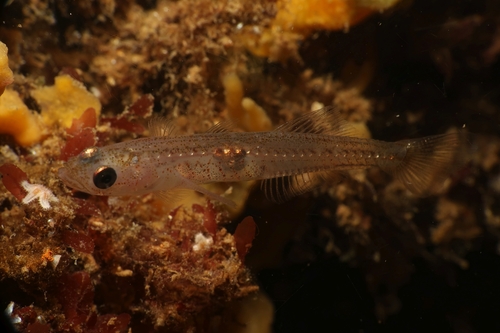
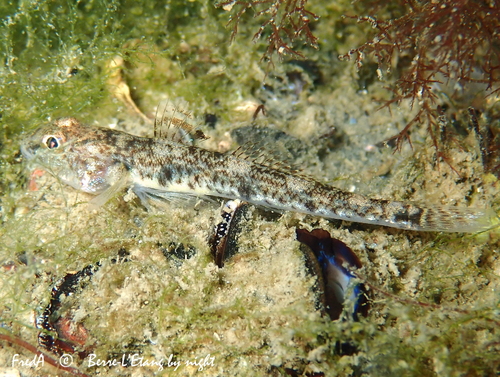
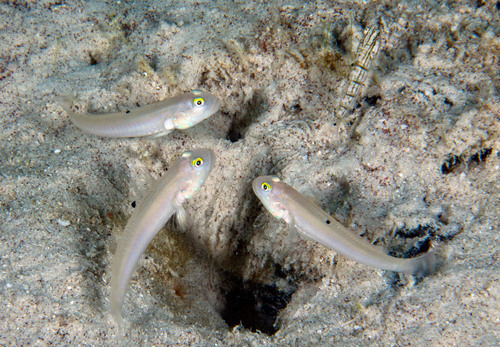
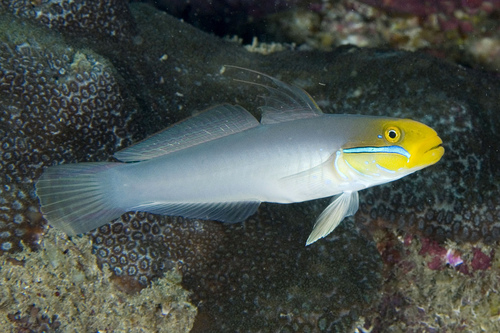
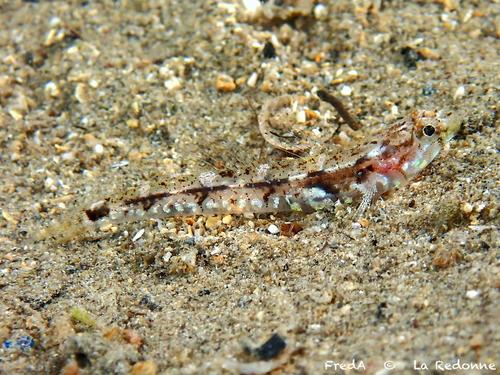
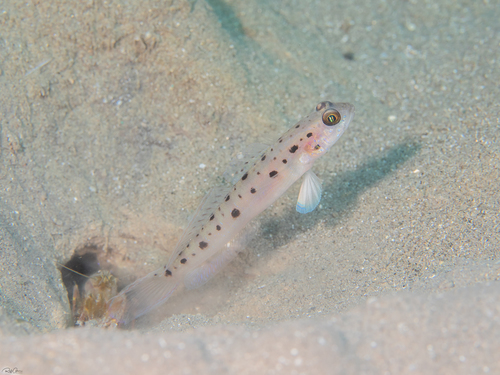
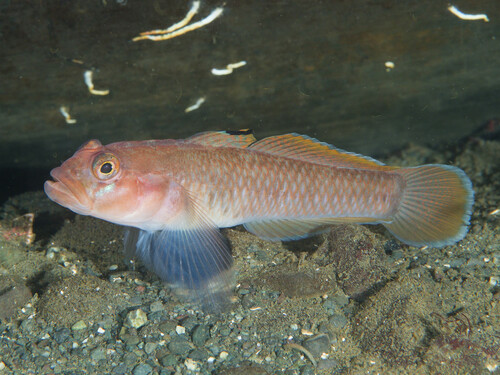
Blackeye gobies (scientific name Rhinogobiops nicholsii) can be easily identified by a fleshy crest on the upper surface of their heads, a distinctive black upper anterior edge on the first dorsal fin, large scales, and large dark eyes. They are small fish that reach a maximum length of only 15 cm (6 in). Their bodies are elongated, slightly compressed, and almost completely covered in scales. The scaleless head is wider than it is deep, with a small terminal mouth, a projecting lower jaw, and a maxilla that does not extend below the anterior margin of the eye. Conical teeth are arranged in double rows on both jaws. The eyes are oriented slightly upwards and sideways. The two dorsal fins are positioned close together; the first dorsal fin has 5 to 7 rays, and the second has 12 to 15 rays. The pectoral fins have 21 to 24 rigid rays, while the anal fin has 11 to 14 rays and no spines, and is roughly the same size as the second dorsal fin. The rounded caudal fin has around 17 rays, 12 of which are segmented and branched. The pelvic fins are completely fused into a disk-shaped structure with four rays per fin, which functions as a sucker. Coloration is variable, as blackeye gobies can rapidly change color during social interactions and for camouflage. Their base body color ranges from creamy white to pale tan, but can shift to a mottled dark purple-brown. The body is irregularly speckled with metallic blue-green, and an iridescent bluish spot visible under light sits below the eye, which gives the species its other common name, bluespot goby. The distinctive black upper anterior edge of the first dorsal fin stays visible even when the fish changes color. During breeding season, the normally gray pelvic fins of males turn jet black.
Blackeye gobies are found in the eastern North Pacific, along the coasts of Canada, the United States, and Mexico, ranging from as far north as St. John Baptist Bay (near Partofshikof Island) in Alaska to as far south as San Martin Island in Baja California, Mexico. The species does not extend into the Gulf of California. Previously, its northern range was thought to only reach Skidegate Channel in the Haida Gwaii Archipelago and waters around Wales Island, both in British Columbia. However, a 2000 survey recovered blackeye gobies from Sitka and Klawock in southeastern Alaska, making this the only known goby species found in Alaskan waters; the arrow goby (Clevelandia ios) and bay goby (Lepidogobius lepidus) have only been found as far north as northern British Columbia. Subsequent aquarium observations of recovered specimens found that blackeye gobies can only survive in temperatures above 4 °C (39 °F), meaning they are unlikely to occur further north than St. John Baptist Bay. This species is extremely abundant. It is exclusively marine, and typically inhabits rocks and reefs from intertidal areas down to 60 m (200 ft) depth, though individuals have been found as deep as 106 m (348 ft). They are most common in the border zone between reefs and sand bottoms. They usually use natural crevices and holes in rock and reef surfaces, but can dig their own burrows in softer substrates when needed. They are hard to spot because they stay completely still until approached closely, and dart quickly back to shelter when threatened.
Blackeye gobies are highly territorial. Each male usually guards a harem of 2 to 8 females and a small territory centered on a shelter. They are diurnal and primarily prey on small crustaceans and mollusks. They are protogynous hermaphrodites: all individuals are born female, and become male once they reach a certain size under the right conditions. They perform courtship displays and breed between April and October, and their larvae are pelagic. Blackeye gobies are sexually dimorphic: sexes can be distinguished by genital papilla, body size, and the length of the dorsal and anal fins. Females reach sexual maturity at 4.73 to 7.35 cm (1.86 to 2.89 in) in length, while males mature at 7.21 to 8.3 cm (2.84 to 3.27 in). The breeding season lasts 5 to 7 months between April and October, during which the fused pelvic fin disk of males turns very dark. Males first prepare a nesting site by fanning, rubbing, scooping, and nibbling the selected area. They then entice females to the nesting site by swimming up 0.61 m (2 ft) or more with an open mouth and outstretched fins, then swimming back down. After doing this once or multiple times, they return to cleaning the nest, and may sometimes rush toward females. Uninterested females often swim away to shelter, and males will chase them, frequently nipping their fins. Interested females approach the male directly, slowly undulate their body, open their mouth widely, and spread their fins. Females lay a single layer of around 1700 eggs on the bottom surface of the nest, and may spawn multiple times. Males follow females as they lay eggs, constantly nipping and bumping them, and fertilize the eggs during or immediately after laying. The spindle-shaped eggs attach directly to rock surfaces, and are pinkish to orange when freshly laid before darkening as they mature. Males guard the eggs until they hatch 10 to 33 days after laying. Newly hatched planktonic larvae are 3 mm (0.12 in) long and grow rapidly. They are pelagic, and can be found more than 104.6 km (65.0 mi) from shore at depths of several thousand feet. Unlike adults, larvae have dark-orange vertical bands. They mature after their first winter, and the maximum recorded lifespan for a blackeye goby is five years.