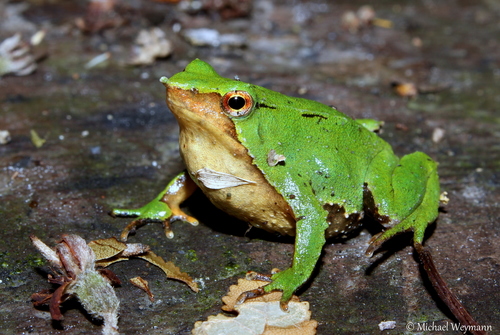
About Rhinoderma darwinii Duméril & Bibron, 1841
Darwin's frog (Rhinoderma darwinii), also called the Southern Darwin's frog, is a species of frog in the family Rhinodermatidae. It was discovered by Charles Darwin during his voyage on HMS Beagle to Chile. In 1841, French zoologist André Marie Constant Duméril and his assistant Gabriel Bibron described and named the species. The diet of R. darwinii consists mostly of herbivorous invertebrates. R. darwinii is currently classified as an endangered species by the International Union for Conservation of Nature. Darwin's frog has an unusual brooding method, where the male facilitates tadpole development inside his vocal sac. This male brooding may make Darwin's frog unique among living frog species, because the only other frog with this behavior is R. rufum (the northern Darwin's frog), which has been presumed extinct since 1981.
Darwin's frog is found in Chile and Argentina at elevations up to 1350 meters above sea level. It occurs mainly in the Valdivian Temperate Rain Forest, which spans parts of both Chile and Argentina. In Chile, its range extends from Concepción Province to Palena Province; in Argentina, it ranges across Neuquén Province and Río Negro Province. It can be found in glades, forested areas, bogs, and near slow-moving streams, across a variety of vegetation types, generally at altitudes up to about 1,100 m (3,600 ft) above mean sea level. Optimum habitat for the species is a mixture of grassland, mossy areas, coarse woody debris, and young trees and bushes within a mature native forest. Short vegetation retains more water, lowers soil temperature, and provides concealment from predators. The species has a fragmented population and poor dispersal ability. Northern portions of the Valdivian Temperate Rain Forest, its typical habitat, are decreasing due to the expansion of pine and eucalyptus agriculture. This removes habitat for R. darwinii and forces populations south, where southern Valdivian forest is more protected and suitable for the species to inhabit. Dispersal-constrained species distribution models show that R. darwinii lost up to 40% of its habitat between 1970 and 2010. While total suitable habitat for R. darwinii is expected to increase in coming years, the species is unlikely to colonize this new emerging habitat because it cannot disperse long distances to reach these areas. Climate change is also projected to affect habitat availability for R. darwinii: over the coming decades, the species' dispersal is expected to reduce by up to 56%, which means it will become more restricted to isolated local habitats in the future. R. darwinii populations are especially vulnerable to damage from wildfires, and climate change models project dramatic increases in wildfire frequency that will negatively impact the species' habitat. The frog has been recorded in multiple protected areas, including Lanín National Park and Nahuel Huapi National Park in Argentina, and many additional protected parks in Chile.
For reproduction, male R. darwinii call to attract females for mating, and calling has even been observed in males that are actively brooding. R. darwinii uses non-linear vocal phenomena (NLP) to attract and communicate with mates. This species has distinct mating patterns that vary by population and individual body size, though more research is needed to fully understand its mating behavior. No brooding males have been observed copulating with females. Females usually lay 4 to 10 eggs at a time, and males can brood 5 to 8 tadpoles at once. In some cases, females can lay up to forty eggs in a single area of leaf litter.
Rhinoderma darwinii has been used in research to study body size variation in ectotherms. Earlier research supported the hypothesis that larger body sizes in ectotherms are linked to higher seasonality, through a concept called starvation resistance. This hypothesis holds that larger ectotherms are less likely to starve because they can use stored body mass for fuel during periods without food. However, experimental work on R. darwinii supports a different explanation called the hibernation hypothesis. This hypothesis states that greater seasonality leads to longer cold periods, during which ectotherms hibernate. Hibernation is associated with a lower basal metabolic rate, so less energy is expended and less body mass is lost over the hibernation period. This result provides an alternative to the starvation resistance hypothesis. R. darwinii is often selected for this research because it has a broad distribution across varied habitat conditions, which allows researchers to study the same species across different climates. This is an important feature for testing claims about the relationship between body size, seasonality, and climate.

