About Rhinoceros unicornis Linnaeus, 1758
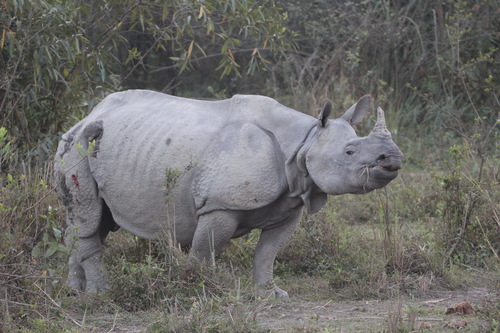
Rhinoceros unicornis, commonly called the Indian rhino, has thick grey-brown skin with pinkish-colored skin folds and a single horn on its snout. Wart-like bumps cover its upper legs and shoulders, and it has very little body hair, only found on eyelashes, ear fringes, and the tip of the tail. Mature males, called bulls, have large prominent neck folds. Its heavy skull has a basal length over 60 cm (24 in) and an occiput over 19 cm (7.5 in). The single nasal horn is slightly back-curved, with a base measuring approximately 18.5 cm (7.3 in) by 12 cm (4.7 in); it narrows rapidly, and a smooth, even stem section begins about 55 mm (2.2 in) above the base. Horns of captive Indian rhinos often wear down into a thick knob. The single horn is present in both adult bulls and females, called cows, but is not present at birth in newborn calves. The horn is made entirely of keratin, the same material as human fingernails, and begins to appear around six years of age. Most adult horns reach about 25 cm (9.8 in) in length, though the maximum recorded length is 57.2 cm (22.5 in) and maximum recorded weight is 3.051 kg (6.73 lb). Among native Asian terrestrial land mammals, the Indian rhino is the second largest, only smaller than the Asian elephant. It is also the second largest living rhinoceros species, outranked only by the white rhinoceros. Bulls have a head and body length of 368–412 cm (12.07–13.52 ft) and a shoulder height of 163–193 cm (5.35–6.33 ft). Cows are smaller, with a head and body length of 310–340 cm (10.2–11.2 ft) and a shoulder height of 147–173 cm (4.82–5.68 ft). Average weights are 2,070–2,200 kg (4,560–4,850 lb) for bulls, which are heavier than cows that average around 1,600 kg (3,530 lb); the largest recorded individuals can weigh up to 4,000 kg (8,820 lb). The pinkish color of the skin folds comes from dense blood vessels located under the fold tissues. The increased surface area created by skin folds helps the rhinos regulate their body temperature. Even with their thick skin, Indian rhinos are still vulnerable to bloodsucking parasites including Tabanus flies, leeches, and ticks. Indian rhinos once ranged across the entire northern Indian subcontinent along the Indus, Ganges, and Brahmaputra River basins, spanning from Pakistan to the Indian-Myanmar border and including Bangladesh, as well as southern Nepal and southern Bhutan. They may have also lived in Myanmar, southern China, and Indochina. They naturally inhabit the alluvial grasslands of the Terai and the Brahmaputra basin. Due to habitat destruction and climatic changes, the species' range gradually shrank, and by the 19th century, Indian rhinos only survived in the Terai grasslands of southern Nepal, northern Uttar Pradesh, northern Bihar, northern West Bengal, and the Brahmaputra Valley of Assam. During the Late Pleistocene, the species' range extended into Thailand, Vietnam, and Laos. Rhinoceros remains from the Pleistocene of Southern China that were previously classified as the separate species Rhinoceros sinensis may actually belong to the Indian rhinoceros. Maps from Colonel Gentil confirm the species was present in northern Bihar and Oudh at least until 1770. In 1867, Thomas C. Jerdon wrote the following observation of the species' historical abundance: This huge rhinoceros is found in the Terai at the foot of the Himalayas, from Bhutan to Nepal. It is more common in the eastern portion of the Terai than the west, and is most abundant in Assam and the Bhutan Dooars. I have heard from sportsmen of its occurrence as far west as Rohilcund, but it is certainly rare there now, and indeed along the greater part of the Nepal Terai; ... Jelpigoree, a small military station near the Teesta River, was a favourite locality whence to hunt the Rhinoceros and it was from that station Captain Fortescue ... got his skulls, which were ... the first that Mr. Blyth had seen of this species, ... Today, the species' range has shrunk further to only a few small pockets in southern Nepal, northern West Bengal, and the Brahmaputra Valley. Its remaining habitat is surrounded by human-dominated landscapes, so the rhinos are often found in cultivated areas, pastures, and secondary forests in many regions. In the 1980s, Indian rhinos were regularly sighted in the narrow plain area of the Manas River and Royal Manas National Park in Bhutan. Indian rhino social behavior typically involves solitary bulls. Groups are formed either by cows with their calves, or by groups of up to six subadult rhinos. These groups gather at wallows and grazing areas. The species is most active during early mornings, late afternoons, and at night, and rests during the hottest parts of the day. They bathe regularly, and their skin folds trap water that stays in place even after they leave wallows. Indian rhinos are excellent swimmers, and can run at speeds up to 55 km/h (34 mph) over short distances. They have very good senses of hearing and smell, but have relatively poor eyesight. More than 10 distinct vocalizations have been recorded for the species. Male home ranges measure around 2 to 8 km2 (0.77 to 3.09 sq mi) and overlap with each other. Dominant males generally allow other males to pass through their territories, except during mating season when dangerous fights can break out. Indian rhinos have very few natural enemies; tigers sometimes kill unguarded calves, but adults are rarely attacked due to their large size. Mynahs and egrets feed on invertebrates found on the rhino's skin and around its feet. Tabanus horse-flies regularly bite rhinos. Indian rhinos are also susceptible to diseases spread by parasites including leeches, ticks, nematodes, and the flatworm Bivitellobilharzia nairi. Cases of anthrax and the blood disease sepsis have been recorded in the species. In March 2017, a group of four tigers (one adult male, one adult tigress, and two cubs) killed a 20-year-old male Indian rhinoceros in Dudhwa Tiger Reserve. Attacks like this are very rare, as adult Indian rhinos are generally not vulnerable to predation. Captive bulls reach breeding age at five years old, but wild bulls do not gain social dominance until much later, when they have grown larger. In a five-year field study, only one wild rhino estimated to be younger than 15 years successfully mated. Captive cows can breed as young as four years old, but wild cows usually do not begin breeding until they are six years old. This is likely because they need to reach a large enough size to avoid being killed by aggressive bulls. In the wild, females reach full maturity at around 6.5 years, and males reach full maturity at around 10 years. The average ovarian cycle in cows lasts 5.5 to 9 weeks. Gestation lasts approximately 15.7 months, and the interval between births ranges from 34 to 51 months. Around 10% of calves die before reaching maturity, most from predatory attacks by tigers (Panthera tigris). In captivity, four individual Indian rhinos have lived over 40 years, with the oldest reaching 47 years of age.