About Rhinichthys osculus (Girard, 1856)
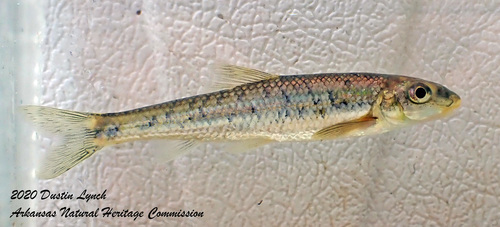
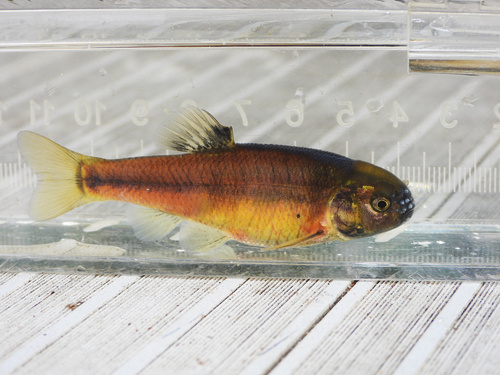
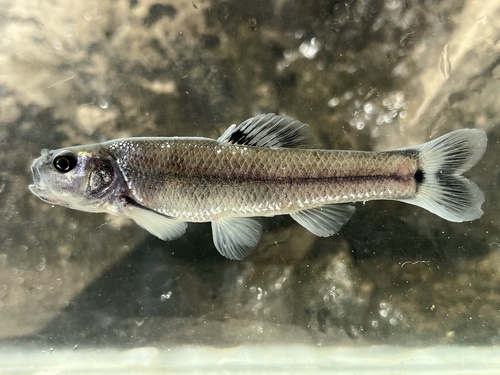
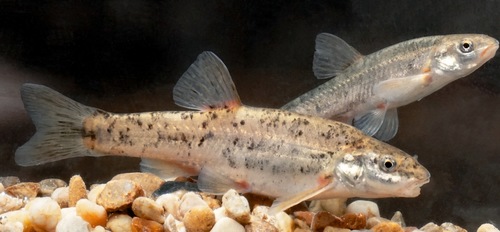
Rhinichthys osculus, commonly known as the speckled dace, is typically a small fish, usually growing less than 8 centimeters. Key identifying traits of the species include a thick caudal peduncle, a bluntly pointed snout, small scales, and small eyes. It has an inferior mouth, and its pharyngeal teeth are strongly hooked with a slight grinding surface; a barbel is typically present at the end of each maxilla. The dorsal fin is positioned behind the pelvic fin, and the anal fin usually has 7 rays. Coloration across the species varies, but most individuals over 3 centimeters have dark speckles across the back and sides, dark blotches on the side, a spot at the base of the caudal peduncle, and a stripe on the head. The body is usually darker yellow to darker green, while belly color ranges from yellow to white. During the breeding season, the fin bases of both males and females turn orange to red; males often additionally develop red snouts and lips. The Foskett speckled dace subspecies, which lives in the harsh desert waters of the Great Basin spanning parts of southeastern Oregon and Nevada, has been listed as threatened under the U.S. Endangered Species Act since 1985. From 2011 to 2016, the Foskett speckled dace population fluctuated between a low of 1,728 and a high of 24,888. Before the subspecies was listed, its population was estimated at 1,500 to 2,000. In 2018, U.S. Fish and Wildlife Service officials proposed removing federal protections for the subspecies. Robyn Thorson, the Service's Pacific Region Director, stated: "We attribute this impressive accomplishment to our partners who have worked so hard on the recovery of the dace. This news builds on other recent successes, including two Oregon fishes that were delisted due to recovery, the Oregon chub and the Modoc sucker." The speckled dace is the only fish native to all major Western drainage systems that extend from Canada south to Sonora, Mexico. It has the widest geographic range of any freshwater dispersing fish in western North America. Studies have identified three major genetically distinct lineages in California that align with the geologic history of the state. Within these groups, the species is native to 12 major areas in California: Death Valley, Owens Valley, eastern Sierra drainages, Surprise Valley, Klamath-Trinity Basin, Pit River drainage, Sacramento drainage, the Lorenzo, Pajaro, and Salinas Rivers, San Luis Obispo, Pismo, and Arroyo Grande Creeks, Morro Bay drainage, and the San Gabriel, Santa Ana and Los Angeles river basins. Studies indicate that even within the Klamath-Trinity Basin there are three genetically distinct groups, named for their geographic distributions: Klamath, Trinity, and Jenny. Canada marks the northern limit of the speckled dace's distribution, and there the species is only found in isolated sections of the Kettle and Granby Rivers. Along with the Salish sucker (Catostomus sp.), the speckled dace may have been one of the first fish to recolonize British Columbia's rivers after the last Ice Age. It is believed that Canadian populations spawn once a year during the summer, and only fish older than two years spawn. During breeding, many males typically accompany a single female, who broadcasts adhesive eggs over gravelly stream beds. Canadian populations of the speckled dace were last sampled in 1977, when only 400 individuals were collected. Few of the caught fish were adults, which suggests mortality for the species may be high in this region. However, there is not enough data available to accurately determine if the Canadian population is self-sustaining or in decline. The speckled dace arrived in streams of the Los Angeles area approximately 1.9 million years ago.