About Rhinichthys cataractae (Valenciennes, 1842)
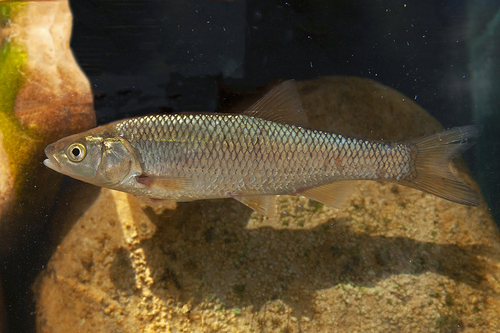
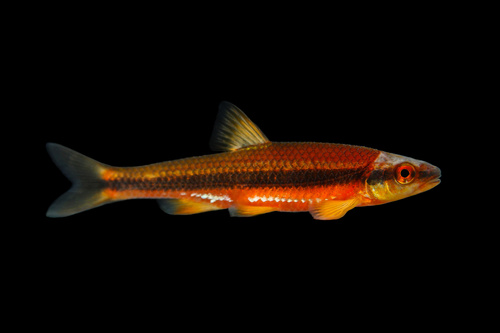
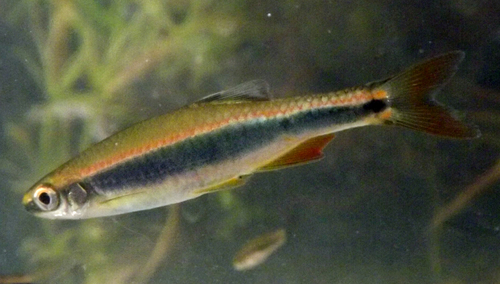
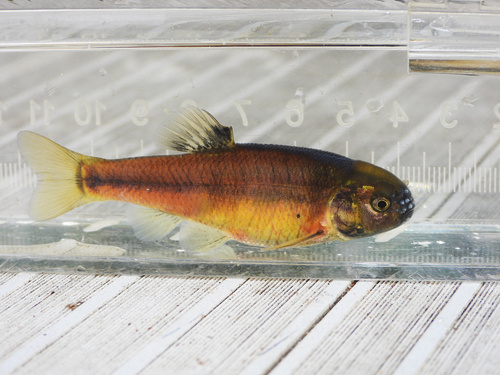
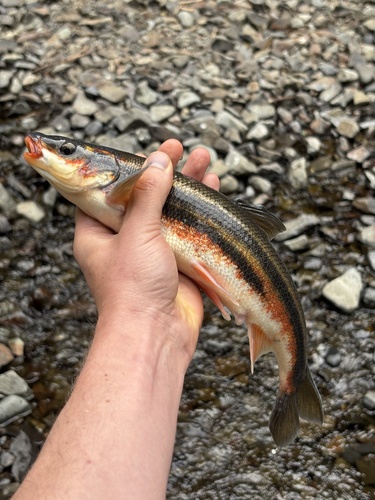
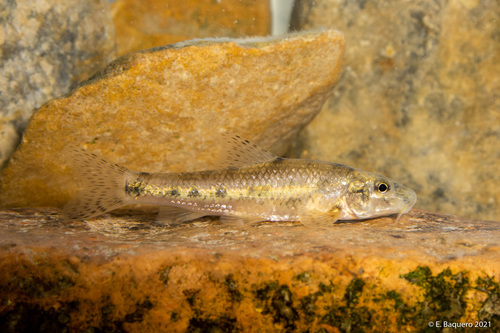
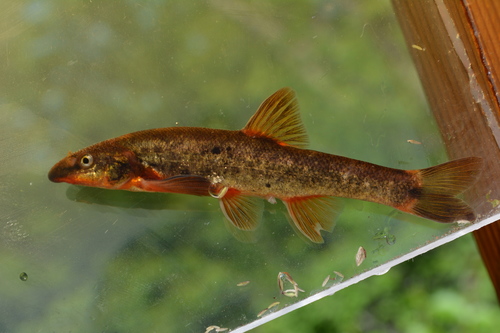
Longnose dace, Rhinichthys cataractae, can be mistaken for suckers due to their subterminal sucker-like mouth. However, like all members of the cyprinid family, longnose dace do not have small fleshy mouth projections called papillae. Juvenile longnose dace have a black lateral line that runs from the front of the eye to the caudal fin; this line fades as the fish matures, and it does not appear in all juvenile populations. In adults, the dorsal side is dark green to black, the lateral side ranges from dark to silvery and often has mottling, and the ventral side is pearly. Both adult males and females can develop bright orange-reddish colouration on the upper lip and at the base of the pectoral, pelvic, and anal fins. This colouration is typically linked to breeding males in the proposed subspecies Rhinichthys cataractae cataractae, though the validity of this subspecies has not been confirmed. Museum specimens show females also have intense orange-reddish colouration in these areas, so this colour cannot be used to accurately predict a longnose dace's sex. The maximum recorded length of the species is 170 mm (6.7 in), but most individuals are less than 100 mm (3.9 in) long.
Longnose dace have the widest distribution of any cyprinid in North America. Their range extends south to the Rocky Mountains in northern New Mexico, north to the Mackenzie River near the Arctic Circle, and spans the continent from the Pacific to the Atlantic coast. Multiple glacial refugia during the most recent glacial maximum is a proposed explanation for the species' broad range. Up to three separate Pleistocene glacial refuges have been identified: Pacific, Mississippi, and Atlantic. Longnose dace on the Quebec peninsula most likely originated only from the Atlantic refuge, unlike other fish species on the peninsula that descend from multiple refugia. Longnose dace in northwestern North America originated from the Pacific refuge.
Longnose dace live in moderately cool streams, rivers, and lakes, with water temperatures reaching up to 22 °C (72 °F). They are a benthic species that preferentially occupies rock and gravel substrate. During the day, longnose dace hide under rocks. They favour shallow, fast-moving riffles in streams and rivers, and the turbulent near-shore region of lakes. Longnose dace are opportunistic foragers. Small individuals (≤ 50 mm / 2.0 in) primarily eat algae and benthic invertebrates. Larger individuals (over 50 mm / 2.0 in) feed on fish scales, fish eggs, terrestrial insects, and aquatic benthic macroinvertebrates, though their diet varies with season. They feed at night, which may be an adaptation to avoid predation and competition with salmonid fish. Most longnose dace have small home ranges and high site fidelity, but evidence shows a small portion of individuals can disperse over distances greater than 500 km (310 mi).