About Rhinichthys atratulus (Hermann, 1804)
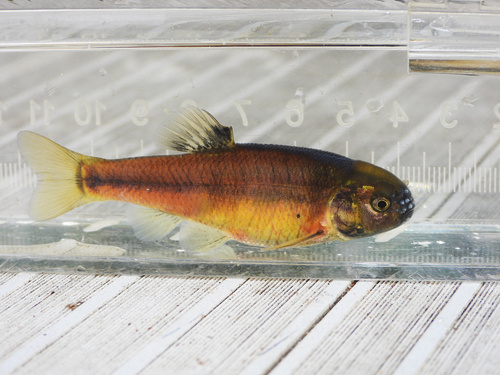
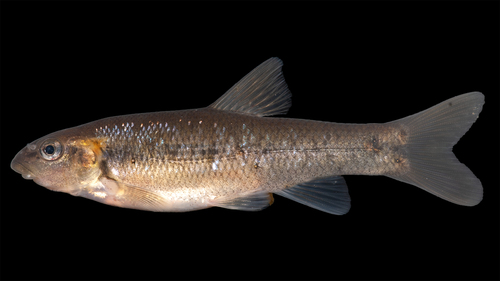
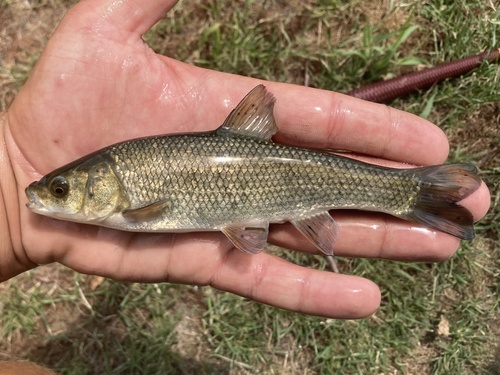
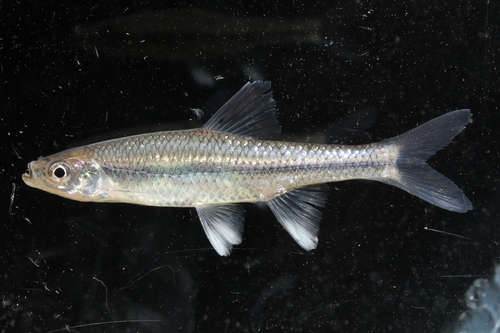
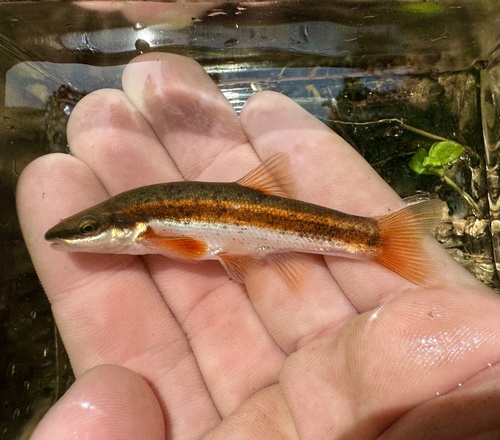
Eastern blacknose dace, scientifically named Rhinichthys atratulus (Hermann, 1804), has the following physical characteristics. Newly hatched fry measure 5 mm (3⁄16 in) long, while the largest individuals can grow slightly over 100 mm (3.9 in). This species typically lives two to three years, growing continuously throughout its lifespan. It has a fusiform body shape with a subterminal mouth. Its darkly colored lateral line runs across 56 to 70 scales from the anterior to posterior end of the body. Above the lateral line, body color ranges from dark brown shades to olive, while color below the lateral line lightens progressively to a white belly. The caudal fin is forked, and the single dorsal fin holds 8 fin rays with no spines. It has one pair of pectoral fins and one pair of abdominal ventral fins, plus an anal fin with 7 rays. All fins are clear to yellow, but breeding males develop an orange to red tint on all fins and along the lateral line.
For distribution and habitat, this fish occurs mainly along the southern border of Canada, ranging from Manitoba to the Atlantic Ocean. Its range extends south along the United States' East Coast, reaching slightly inland to South Carolina and Georgia. Scientists hypothesize that 20,000 years ago, as glaciers retreated, blacknose dace recolonized this region from a single glacial refugium located in what is now Connecticut, just 75 years after the ice retreated. Adults typically inhabit headwaters, creeks, and small rivers with fast-moving water, while fry mature in slower moving sections of these habitats, such as shoals and pool margins. The species as a whole prefers cool, rocky areas, and uses stones to rest under and around. It also uses overhanging vegetation and undercut banks for additional shelter. In winter, individuals migrate from headwater streams into rivers, and can be found in deeper water under banks.
Regarding reproduction, eastern blacknose dace spawn between May and June, in shallow water over gravel riffles. During the breeding season, males develop nuptial tubercles on multiple parts of the body, including the head and fins. Males also develop orange-red coloration along the lateral stripe and on the pectoral fins. Males of this species are nonterritorial, and each mates with a single female. Eggs are laid into simple nests, which are gravel depressions created by vigorous movement during spawning. Larger females have higher fecundity, laying between 400 and 1,100 eggs. After eggs are deposited, there is little to no parental care for the young.