About Rhinella marina (Linnaeus, 1758)
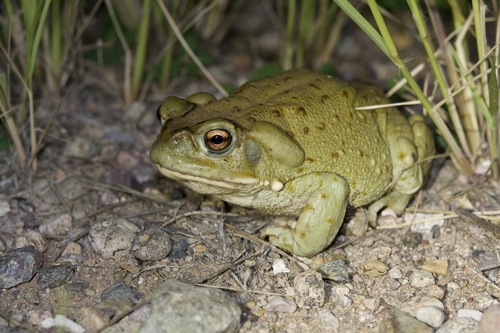
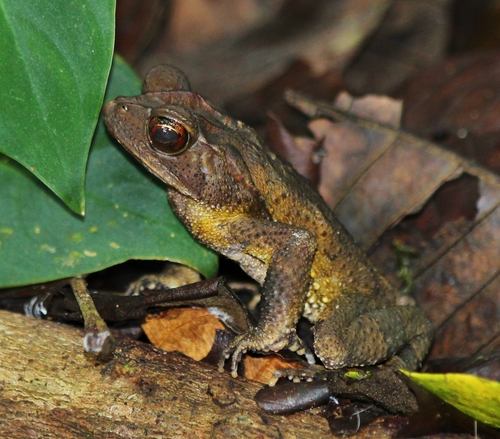
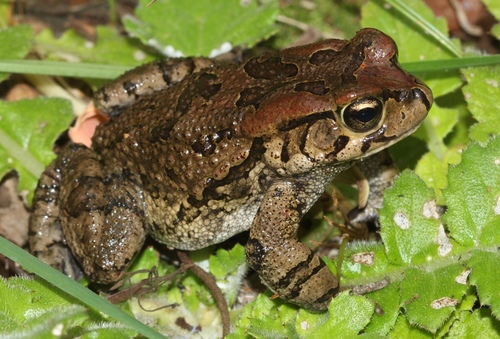
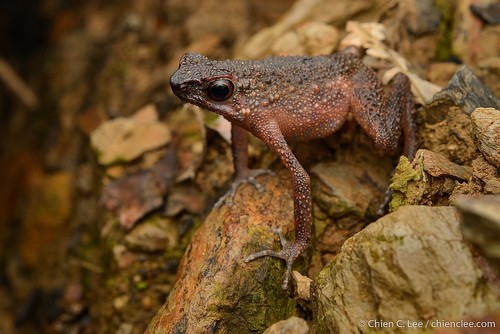
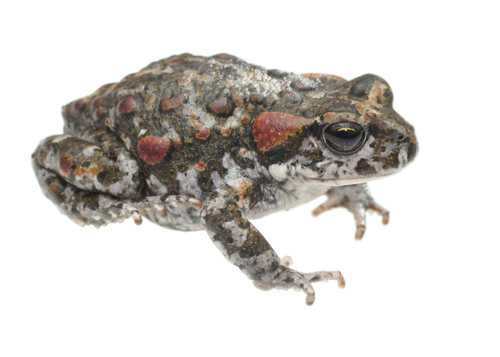
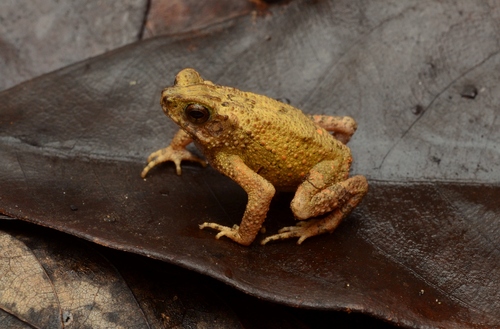
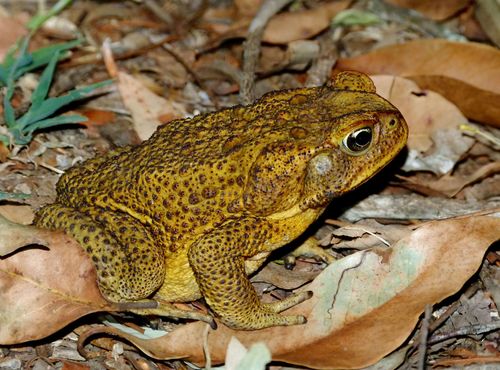
Rhinella marina, commonly called the cane toad, is considered the largest species in the Bufonidae family. The species reaches very large sizes, with females growing significantly longer than males: females typically reach 10–15 cm (4–6 in) in length, with a maximum recorded length of 24 cm (9.4 in). Larger individual toads are usually found in areas with lower population density. Cane toads have a wild life expectancy of 10 to 15 years, and can live much longer in captivity; one specimen is reported to have survived for 35 years. Adult cane toads have dry, warty skin, with distinct ridges above the eyes that run down the snout. Individual toads can be grey, yellowish, red-brown, or olive-brown, with varying patterns. A large parotoid gland sits behind each eye. The ventral (belly) surface is cream-coloured, and may have black or brown blotches. Cane toads have horizontal pupils and golden irises. The toes have fleshy webbing at their base, while the fingers have no webbing. Juvenile cane toads typically have smooth, dark skin, though some individuals have a red tint. Juveniles do not have the large parotoid glands of adults, so they are usually less poisonous. Cane toad tadpoles are small, uniformly black, bottom-dwelling, and tend to form schools. Tadpoles measure 10 to 25 mm (0.4 to 1.0 in) in length. The cane toad is native to the Americas, where its native range stretches from the Rio Grande Valley in South Texas to the central Amazon and southeastern Peru, and includes some continental islands near Venezuela, such as Trinidad and Tobago. This native range covers both tropical and semiarid environments. Cane toad density is significantly lower in its native distribution than in regions where the species has been introduced. In South America, recorded density is 20 adults per 100 m (110 yd) of shoreline, which is only 1 to 2% of the density found in Australia. The common name 'marine toad' and the scientific name Rhinella marina suggest a connection to marine life, but cane toads do not live in the sea. However, laboratory experiments show that cane toad tadpoles can tolerate salt concentrations equal to 15% of seawater (~5.4‰), and recent field observations have found living tadpoles and toadlets at salinities of 27.5‰ on Coiba Island, Panama. Cane toads live in open grassland and woodland, and show a distinct preference for human-modified areas such as gardens and drainage ditches. In their native habitats, toads can be found in subtropical forests, though dense foliage tends to limit their dispersal. Cane toads begin life as eggs, laid in long strings of jelly in water. A single female lays 8,000–25,000 eggs at once, and the egg strings can stretch up to 20 m (66 ft) in length. The black eggs are covered by a membrane, and have a diameter of about 1.7–2.0 mm (0.067–0.079 in). The development rate from egg to tadpole increases with temperature. Tadpoles typically hatch within 48 hours, but the hatching period can range from 14 hours to almost a week. Thousands of small, black, short-tailed tadpoles usually form groups after hatching. Tadpoles take between 12 and 60 days to develop into juveniles, with four weeks being the typical timeline. Like adult toads, cane toad eggs and tadpoles are toxic to many animals. When they finish metamorphosis, toadlets are typically 10–11 mm (0.39–0.43 in) in length, and grow rapidly. While growth rate varies by region, time of year, and sex, the average initial growth rate is 0.647 mm (0.0255 in) per day, followed by an average rate of 0.373 mm (0.0147 in) per day. Growth typically slows once toads reach sexual maturity. This rapid growth is important for survival: between metamorphosis and subadulthood, young toads lose the toxicity that protected them as eggs and tadpoles, but have not yet fully developed the parotoid glands that produce bufotoxin. Only an estimated 0.5% of cane toads reach adulthood, in part due to this lack of key defense, and also due to tadpole cannibalism. While cannibalism occurs in native South American populations, rapid evolution in the unnaturally large Australian population has produced tadpoles 30 times more likely to seek out and cannibalise their siblings, and 2.6 times more likely to actually do so. Australian cane toad tadpoles have also evolved to shorten their tadpole phase in response to the presence of older tadpoles. These changes are likely genetic, though no specific genetic basis has yet been identified. Like growth rates, the point at which toads reach sexual maturity varies across regions. In New Guinea, female cane toads reach sexual maturity at a snout–vent length between 70 and 80 mm (2.8 and 3.1 in), while toads in Panama reach maturity when they are between 90 and 100 mm (3.5 and 3.9 in) in length. In tropical regions, including the species' native habitats, breeding occurs year-round, but in subtropical areas, breeding only happens during warmer periods that align with the start of the wet season. The estimated critical thermal maximum for cane toads is 40–42 °C (104–108 °F), and the critical thermal minimum is around 10–15 °C (50–59 °F). These ranges can shift due to adaptation to local environments. Cane toads from some populations can adjust their thermal tolerance within a few hours of exposure to low temperatures. The species can rapidly acclimate to cold through physiological plasticity, and there is also evidence that more northerly cane toad populations in the United States are better cold-adapted than more southerly populations. These adaptations have allowed the cane toad to establish invasive populations across the world. The toad's ability to rapidly acclimate to thermal changes means current models may underestimate the potential range of habitats the species can colonize. Cane toads also have a high tolerance for water loss; some individuals can withstand a 52.6% loss of body water, allowing them to survive outside tropical environments. Aside from its use as a biological control for pests, the cane toad has been used in a number of commercial and noncommercial applications. Traditionally, within the toad's natural South American range, the Embera-Wounaan people would milk toads for their toxin, which was then used as an arrow poison. The Olmec people may have used the toxins as an entheogen. The toad has been hunted as a food source in parts of Peru, and eaten after careful removal of the skin and parotoid glands. When properly prepared, the toad's meat is considered healthy and is a source of omega-3 fatty acids. More recently, the toad's toxins have been used in several new ways: bufotenin has been used in Japan as an aphrodisiac and a hair restorer, and in cardiac surgery in China to lower patients' heart rates. New research suggests that cane toad poison may have applications in treating prostate cancer. Other modern applications of the cane toad include pregnancy testing, use as pets, use in laboratory research, and production of leather goods. Mid-20th century pregnancy testing was done by injecting a woman's urine into a male toad's lymph sacs; if spermatozoa appeared in the toad's urine, the patient was confirmed to be pregnant. Toad-based tests were faster than mammal-based tests, and toads were easier to raise. While the 1948 initial discovery used Bufo arenarum for testing, it was soon found that a variety of anuran species, including the cane toad, were suitable. As a result, toads were used for this task for around 20 years. As a laboratory animal, the cane toad has many advantages: they are plentiful, and easy and inexpensive to maintain and handle. Use of the cane toad in experiments began in the 1950s, and by the end of the 1960s, large numbers were being collected and exported to high schools and universities. Since that time, a number of Australian states have introduced or tightened import regulations. There are several commercial uses for dead cane toads. Cane toad skin is made into leather and novelty items. Stuffed, posed and accessorised cane toads are sold as souvenirs to tourists. Attempts have also been made to produce fertiliser from toad carcasses.