About Rhinecanthus verrucosus (Linnaeus, 1758)
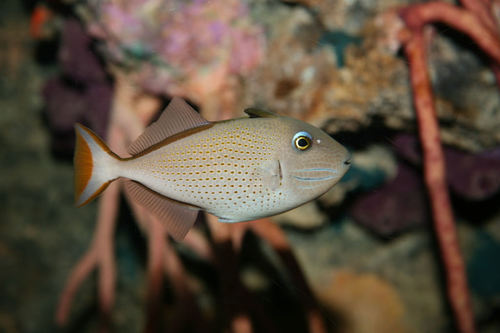
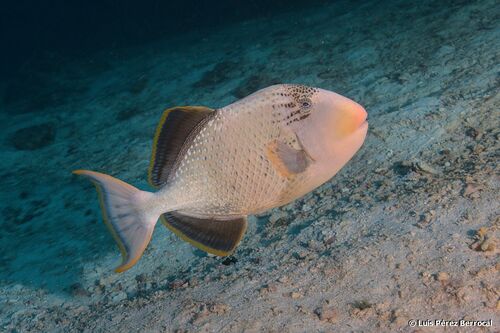
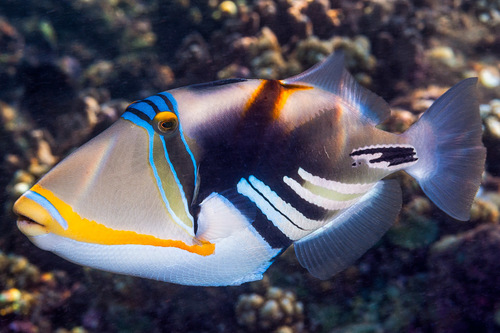
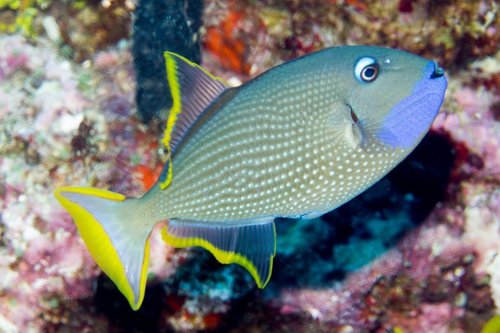
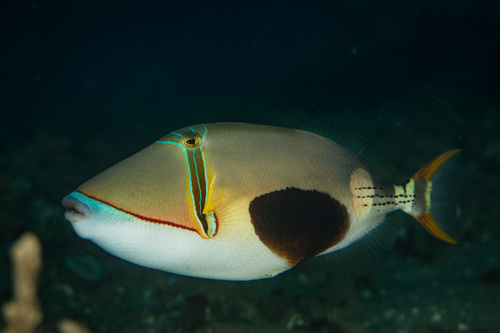
Rhinecanthus verrucosus, commonly called the blackbelly triggerfish, has a laterally compressed, deep body with a long snout, and an overall rhomboidal shape. It reaches a maximum total length of 23 cm (9.1 inches). Its mouth sits at the tip of the snout, and its eye is positioned high on a long, straight forehead. The upper half of its body is pale brown, while its underparts are white. It has a dark brown streak below the eye, and a very large black spot on its underside just in front of the anal fin. Three short rows of forward-pointing spines are present on its caudal peduncle. The anterior section of its dorsal fin is made up of three spines that can be retracted into a groove, and the separate posterior section has 23 to 26 soft rays. The anal fin matches the shape of the posterior dorsal fin very closely, and has 21 to 23 soft rays. The pectoral fin has 13 to 14 rays. The pelvic fin is almost entirely covered by a flap of skin, with only its extreme tip exposed. This species is native to shallow Indo-Pacific waters, where its range extends from the Seychelles and Chagos Islands to Japan, Vanuatu, and Australia. A single individual, likely released from an aquarium, was spotted near Boca Raton, Florida in 1995. The blackbelly triggerfish is a territorial fish that defends its territory against other triggerfish, including the lagoon triggerfish (Rhinecanthus aculeatus). It inhabits lagoons and reef flats, and prefers areas with seaweed, corals, seagrasses, sandy flats, and stony substrates. It may shift its location in response to changing tide conditions.