About Rhinecanthus aculeatus (Linnaeus, 1758)
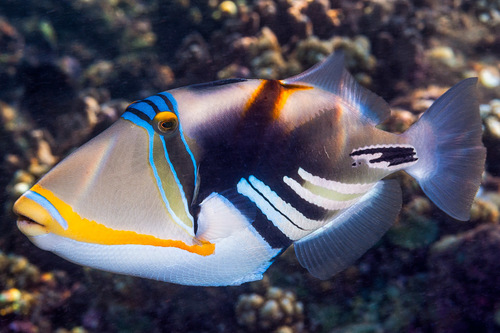
Rhinecanthus aculeatus, commonly called the lagoon triggerfish, blackbar triggerfish, Picasso triggerfish, or Picassofish, is a triggerfish species that grows up to 30 cm (12 in) in length. It occurs on reefs in the Indo-Pacific region, and has been the subject of a wide range of scientific research, covering topics from locomotion to color vision. Both male and female lagoon triggerfish hold individual territories. Some individuals maintain their territories for eight years or longer, and males hold territories for significantly longer than females on average. A typical male territory overlaps with between one and five female territories, so the species is described as having a haremic mating system, though this system remains understudied; similar mating systems are observed in other members of the triggerfish family Balistidae. If a territory holder of either sex is removed or disappears, a new fish quickly takes over its territory. This species reproduces multiple times over the course of an individual’s lifespan. Pair spawning occurs around sunrise, and egg masses are attached to sand, coral rubble, or algae. Eggs hatch on the same day as spawning, around sunset. While paternal care is typical for teleost fishes that use external fertilization, mother lagoon triggerfish are the ones that guard and care for eggs until they hatch. The mother stays above her eggs for approximately 12 to 14 hours, and spends around 30% of this time fanning the eggs with her pectoral fins to improve oxygen flow. She chases away most approaching fish, and removes other intruders such as starfish by mouth. This maternal care effectively prevents egg predation; experiments that removed mothers from egg masses reduced egg survival to almost zero, indicating that this behavior is adaptive. While caring for eggs, mothers forage less than fathers and cover a smaller foraging area near the egg mass. Because males in this species mate with multiple partners, caring for an egg mass would likely carry a high cost in lost mating opportunities, so maternal care is considered an evolutionarily stable strategy for this species.